
Ignite the Pulpit
Clergy: A Hopeful State of Hopelessness

Many media outlets have done interviews with members of the clergy regarding the cultural issues of the day. It is truly amazing how they attempt to label the many crises we are facing today without looking in the mirror: it’s the unemployment rate, the welfare system, the education system, yadda yadda yadda.
Let me be clear, I have a great amount of respect for many members of the clergy. However, there are a great many who should be doing all within their power to heal the soul of America and instead they seem to be striking the final blows.
Barack Obama isn’t a member of the clergy, but he has astonishingly failed the Black community. With a 14.2% soaring unemployment rate that eclipses the rate for other demographic groups in the country, and a message that capitalizes on division rather than healing, I just can’t understand why so many continue to rally around him. Worse, where are the clergy? Where are the men and women of God who are supposed to be preaching love instead of hate? Healing instead of crucifixion?
Sure, I understand that by writing this article I am opening myself up to all kinds of criticism, but some things just need to be said. Here’s the skinny from my point of view:
Constitutional compromise didn’t work out: slavery
The history of slavery in America is a terrible scar upon an otherwise noble nation. I acknowledge that and never would minimize it in any way, shape or form. I’ll go a bit further, it’s hard for me to understand how our Founders who loved liberty could justify enslaving others. I don’t want to hear the argument that it was part of the cultural environment. It was wrong and it was hypocritical. Some of the same men who wrote “all men are created equal” owned slaves. It’s indefensible. They compromised when they wrote the Constitution and had the opportunity to end slavery in America. They didn’t do it. A wise friend once said that the road to hell is paved with compromise. I believe he was right. However, I also acknowledge that there were thousands upon thousands who laid down their lives in the Civil War so others could be free – a point that is often overlooked in Black theology.
Are the clergy misplacing their hope?
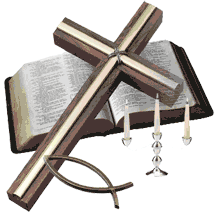
A cross, a Bible, and an ancient symbol from a time when Christians met literally underground. Graphic art courtesy Microsoft Corporation. Used to illustrate a faith that some clergy might have forgotten.
Here’s the point. Hope being placed in a human being – any human being – even a president, is hope misplaced. As a Christian I can state with affirmation that hope exists in the person of Jesus Christ. It’s a message the church has neglected to preach – and it’s a message that is needed as much today as it was back in 1860. The clergy is supposed to understand that message. But when asked about how to solve the problems the black community is facing, I’ve never heard any preacher say that the power to change and the power to clean one’s proverbial slate is possible. It’s the message of redemption that only Christ offers – it’s the “good news” or the gospel. You can be a new creature in Christ. Where hope exists, hate can be overcome.
The Bible also teaches that there should be no division between us. And it teaches that we are to forgive those who wrong us. It doesn’t teach that we are supposed to hold a grudge against one generation for the sins of another. There can be no healing in this country unless we acknowledge our national sins and forgiveness is preached. Then and only then can people rise up against poor circumstances and be all God would have them be.
So that’s my preaching for the day. Too bad you had to hear it from a housewife living in the hills of New Jersey instead of from the pulpit.
By the way, my ancestors didn’t live in America at the time slavery was accepted. They came here at the beginning of the 20th century. So, although I am repenting of the sins of this nation, my hands are clean of this particular atrocity. Healing has to start somewhere – let it start here and let it start now.
[amazon_carousel widget_type=”ASINList” width=”500″ height=”250″ title=”” market_place=”US” shuffle_products=”True” show_border=”False” asin=”184902670X, 1932225412, 1932225277, 1932225633, 193222503X, 145071398X, 1604592680, 0925279366, 0915815710, 1932225099″ /]



RoseAnn Salanitri is a published author and Acquisition Editor for the New Jersey Family Policy Council. She is a community activist who has founded the Sussex County Tea Party in her home state and launched a recall movement against Senator Robert Menendez. RoseAnn is also the founder of Veritas Christian Academy, as well as co-founder of Creation Science Alive, and a national creation science speaker.
-
 Executive2 days ago
January 6 case comes down to selective prosecution
-

 Executive1 day ago
Biden ballot woes continue
-

 News2 days ago
Rolling the Dice on Republicans: Has the Right Become Delusional?
-
 Civilization2 days ago
President Biden Must Not Encourage Illegal Mass Migration From Haiti
-

 Executive2 days ago
Why Fatal Police Shootings Aren’t Declining: Some Uncomfortable Facts
-

 Guest Columns2 days ago
What Was Won in No Labels’ Crusade
-
 Civilization2 days ago
Biology, the Supreme Court, and truth
-
 Constitution2 days ago
Equality Under the Law and Conflicts of Interest in New York
Roseann –
Nice commentary! Spot on! I believe that if any group is more responsible for America’s decline, it is America’s clergy – because, they should know better! And, I believe one of the major reasons America is swirling down the cultural sewer is that clergy have blinded their eyes and plugged their ears to America’s moral challenges. To be sure, the clergy in America are a sorry lot – especially Christian pastors and teachers. They hole up within their worship and educational sanctuaries and are afraid to publicly denounce the moral ills of our crumbling American culture.
Especially are these [so-called] “Christian” clergy guilty of sins of omission for not speaking out against politicians’ political sins and crimes against humanity. They have gagged themselves from telling their congregational flocks who Barack Hussein Obama really is. They will not, in John the Baptist and Jesus Christ fashion warn their flocks about wolves in high places. Most continue to accept the lie that Obama is a Christian, when by Scripture’s [own] standards, he is not! If just 10% more of self identified “Christians” had not voted for Obama the first time around, we would not be facing the major problems which Obama has brought to America with his godless socialistic and anti free enterprise agenda, actions and policies. [Please refer to the following as evidence of my assertion]:
Obama proves, again, he is not a Christian
link to moralmatters.org
Furthermore, Roseann – you say:
“So that’s my preaching for the day. Too bad you had to hear it from a housewife living in the hills of New Jersey instead of from the pulpit.”
Roseann – Never apologize that you are a “housewife.” In my opinion, those preaching from pulpits have missed the boat. The good Lord has taken that pulpit message mantle and placed it upon those who aren’t [active] parish pastors, – people such as you and I. Roseann – never sell yourself short with what you say and proclaim! [Please reference the following, as I offer a link to substantiate my assertion]:
The Priesthood of All Believers and why Christian churches end up, stooping to gimmickry
link to thechristianmessage.org
Pastor emeritus Nathan Bickel
Thank you, Pastor.
This country has to stop calling good evil and evil good. Actually, America needs more pastors like you! Too bad you don’t live in NJ. On Sept. 29th, the NJ TEA Party Caucus will be hosting a God and Country conference. It is our great prayer that God will use this effort to wake up the clergy in the fight for the soul of America.
[…] Clergy: A Hopeful State Of Hopelessness – by Roseann Salanitri – conservativenewsandview… […]