
Let's Talk
Ayn Rand world: public lands

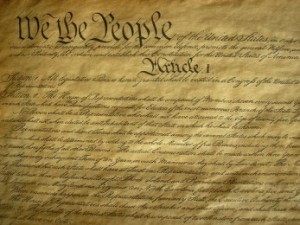
The Ayn Rand would would have no such thing as public land, except for courthouses, other government offices, police and military facilities, and the like. Gary Weiss, among others, laments this. But he does not tell you the dirty secret of public land. The Constitution never authorized it. Worse, Congress carved out the largest federal lands for unworthy and abusive motives.
Ayn Rand and followers on public lands
Ayn Rand herself said little about public parks and other public lands. She mainly said, on principle, that the government should own nothing except what it needs for its proper functions.
Recently her followers described an ugly real-life spectacle, and why that spectacle need not happen in an Ayn Rand world. The “Reverend” Fred Phelps (he may or may not be an ordained minister), “pastor” of the Westboro Baptist Church, organized a picket at the funeral of Matthew Snyder, USMC, who was KIA in Iraq. Albert Snyder, his father, sued him. A year later, the Supreme Court held (Snyder v. Phelps) that Phelps and company were within their rights under the First Amendment, so long as they stayed on the public streets and sidewalks and did not “trespass” on the cemetery.
Tom Bowden, at the Ayn Rand Center, commented last year, and more recently, on this case. He called this ugly affair a classic example of the Tragedy of the Commons:
We take it for granted that streets and sidewalks are, and must be, publicly owned. But look where that leads: Any taxpayer can claim a right to use them as an owner. So, the Westboro Church picketers can self-righteously proclaim to the Supreme Court that they were just exercising their First Amendment rights to speak on public property. If it happened to destroy the solemnity of a funeral, that’s the family’s tough luck.
But in the Ayn Rand world, that street and that sidewalk would have a private owner. That owner would be free to agree, for any price he cared to ask for, to bar anyone from picketing within sight of any funeral at that cemetery. The city couldn’t do that. That would break the First Amendment:
Congress shall make no law…abridging the freedom of speech.
(Note that the Fourteenth Amendment says that no State may “abridge the freedom of speech” either. That is a “privilege and immunity” that all citizens of the United States have.)
But though no government can censor Fred Phelps, private owners can. The problem: no one can “trespass” on property that he owns, in whole or in part. Not on the streets and roads, he can’t.
What the Constitution says
The Constitution gives the Congress only this much power to buy or keep public lands. Article I, Section 8, Clause 17 reads:
The Congress shall have power…to exercise exclusive legislation in all cases whatsoever, over such district (not exceeding ten miles square) as may, by cession of particular states, and the acceptance of Congress, become the seat of the government of the United States, and to exercise like authority over all places purchased by the consent of the legislature of the State in which the same shall be, for the erection of forts, magazines, arsenals, dockyards, and other needful buildings.
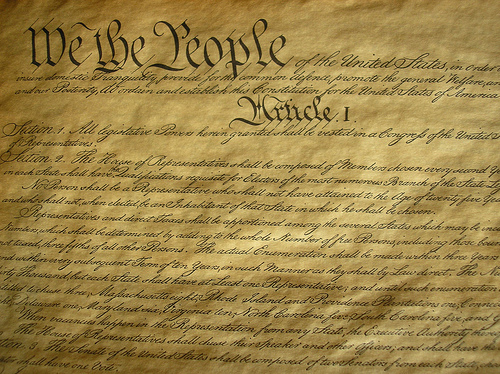
The US Constitution. Photo: National Archives of the United States
So the Congress may carve out a federal city, which it did in 1800. We call it Washington, DC. And Congress may buy land to build far-flung federal offices, Army posts, Navy and Air Force bases, and everything that the government needs to support the specific forces that the Constitution authorizes.
What is a “needful building”? Is a public park a “needful building”? It is certainly not a “fort, magazine, arsenal, [or] dockyard.” (Nor an air base.) Nor does it help the Census Bureau, the Mint, the Postal Service, or the Patent Office do its job. And if a needful building is whatever Congress says it needs, then Congress can literally buy or build anything.
[ezadsense midpost]
Furthermore, Congress has broken faith with the Constitution several times in this context. It has set up hundreds of “national monuments” without the consent of the legislatures in the States where they lie. Morris Udall and John Anderson famously locked up millions of acres of land under the Carter administration. The Clinton and Obama administrations have locked up millions more. Without the consent of the legislatures, none of those monuments could be valid in any case. Nor are any of them “necessary [or] proper to the execution” of any of the enumerated powers of Congress, or any of the powers that later Amendments granted to Congress.
Land management in an Ayn Rand world
Public parks
Camping and other “recreation” is a good like any other. If it has value, let those who value it, pay for it. Some people automatically assume that the Ayn Rand world would have no camp grounds or other recreational spaces at all. They do not know this. No one has tried this, so no one can know how valuable “unworked” land might be to those willing to pay to visit it.
Grazing land
The value-for-value equation should be obvious to anyone. In fact, the Bureau of Land Management is a notoriously bad landlord. Nearly every cattle rancher agrees.
National monuments
This is the worst abuse of federal power. Congress took those lands from the States. No State passed a law to let Congress do this. Congress simply said, “This land is federal land,” and that was that. Some of these lands have abundant mineral wealth. And that is why Congress seized them: to stop anyone from extracting the minerals. “Environmentalists” will tell you that Congress sought to stop mining companies from “spoiling” the land. The result is that the United States is poorer for not having those minerals available. That is the real reason for those “monuments.” And once again: without the consent of the State legislatures involved, those land lock-ups are not only unauthorized but are flatly illegal.
Sadly, since the Bush Senior administration, the United States has set up a pretext for yet more land seizures. UN Agenda 21 calls for returning vast tracts of land to the wild, and marking off wildlife “corridors” where no human being may enter except under very special conditions.
Summing up
Thus the Ayn Rand world, in this context, is a Constitutional world. Any movement wanting to restore American liberty would do well to take Ayn Rand’s advice, and that of the Ayn Rand Center. The Constitution already makes most public lands illegal. Congress has no authorization to have them, and got them illegally and without the key protection that Article I, Section 8, Clause 17 gave the States.
This article is part of the Ayn Rand world series.
[amazon_carousel widget_type=”ASINList” width=”500″ height=”250″ title=”” market_place=”US” shuffle_products=”True” show_border=”False” asin=”0451233263, 0452281253, 0451191153, 0452011876, 0451163931, 0451147952, 0451163087, 0451149165, 0452264863, 0452011841″ /]
[ezadsense leadout]

Terry A. Hurlbut has been a student of politics, philosophy, and science for more than 35 years. He is a graduate of Yale College and has served as a physician-level laboratory administrator in a 250-bed community hospital. He also is a serious student of the Bible, is conversant in its two primary original languages, and has followed the creation-science movement closely since 1993.
-

 News22 hours ago
Rolling the Dice on Republicans: Has the Right Become Delusional?
-
 Executive17 hours ago
January 6 case comes down to selective prosecution
-

 Civilization23 hours ago
Biology, the Supreme Court, and truth
-

 Entertainment Today3 hours ago
Waste of the Day: Throwback Thursday: Millions Went To Video Game ‘Research’
-

 Executive2 hours ago
Why Fatal Police Shootings Aren’t Declining: Some Uncomfortable Facts
-

 Constitution50 mins ago
Equality Under the Law and Conflicts of Interest in New York
-
 Guest Columns27 mins ago
What Was Won in No Labels’ Crusade
-
 Civilization5 mins ago
President Biden Must Not Encourage Illegal Mass Migration From Haiti
Say goodbye to Phelps. Say goodbye to the TEA party demonstrations. Say goodbye to *any* demonstrations. Say goodbye to freedom of movement.
A little oversimplified, don’t you think? All the permissions that anyone running a demonstration now has to get, they will apply for from private owners, not a town or city or county. And the applicants would hear back, yes or no, a lot sooner.
And those private owners are guaranteed to grant permission because…
At least with the government, you have the guarantee of freedom of speech. If private land owners controlled access, then you create the ultimate in “hecklers’ vetoes”.
I find your claim that it would be easier to get permits from private land owners to be debatable, too. Let’s say I wanted to hole a protest march down Main Street in the little DC suburb I live in. Right now, I have to get permission from the city government. But in your Randian world, I have to get permission from barbecue place, the eye doctor, the deli, the senior citizens apartment complex, the comic book shop, the post office (presumably privatized in your world), the hait stylist and probably fifty or so more businesses. And if just a handful decide they don’t like my march, I’m dead in the water.
Now, I suppose you could argue they’d organize some kind of business owners group to handle things like that, but then, for the same reasons I argued with you about home owners associations, that is, in effect, a government.
Why do you always want guarantees? What entitles you? You want something? Work it out with someone.
Guarantees? Yes, Terry, I do want a guarantee that my speech will continue to remain free.
The government will not arrest you for it. But freedom of speech does not in and of itself entitle you to a venue for that speech, whether the owner of any given venue wishes to provide it or not. For decades conservatives learned to create their own venues, because the liberals owned the big venues of the day: the Big Three Networks, PBS, NPR, The New York Times, The Washington Post, The Boston Globe, The Chicago Tribune, et cetera. We had no complaint when the only time that we could get on television was after “Sue Cott express[ed] the opinion of the management of WCBS-TV,” and “those having differing opinions [were] invited to request time to reply.” We accepted that “Editorial Reply” was really “An Evening at the Improv.”
Then along came a real professional named Rush Limbaugh. And your side have been trying to shut him down ever since.
So don’t talk to me about guaranteed venues.
In the UK (except outside the Houses of Parliament) you do not legally need any permission from local government or anyone to hold a peaceful demonstration on public rights of way, provided that the demonstration does not completely block usage of the right-of-way by others.
So, in Randistan, practical freedom of speech and freedom of assembly would be drastically curtailed. Regardless of what it said on paper, the practical scope and application of peoples rights would be drastically curtailed from how they stand in the current United Kingdom.
Why should we give up these rights?
Because you’re not entitled to a free-of-charge venue.
Let me get this straight – Terry’s ideal country would have:
* No universal healthcare
* No entitlement programs
* Low, flat taxes
* High reverence for God
* Faith based government
* Strict limitations on abortion
* No same-sex marriage
* Homosexuality outlawed
* Death penalty
* Strong private, religion-based school system
* Drilling for oil
* No environmental worries
* Culture that defines roles for men and women.
Good news! Such a country exists!
Iran.
Shall I help you pack?
There’s a lot more about Iran that you’re leaving out. The restrictions on production and trade, and for that matter on art, alone would be deal-breakers. But all this government engages in all four of the trespasses against the liberty of its people that would justify invasion with intent to rescue. They are:
On what authority do you decide that? That is nothing more than your opinion, one which is not shared by any of the major democratic societies in existence – thankfully.
I do not believe I am alone in holding the right to free speech and assembly as being more important than squeezing every last breath out of civil society in the name of “small government”.
This belief would lead to the practical abolition of free speech. Huge segments of the population would have literally no avenue at all through which they could express their grievances – and that can never create a viable long-term functioning society, a fact which even absolute monarchies realised and made provisions to avoid. Such a society has a built in failure mechanism.
You’re asking the wrong question. The right question is: on what authority do you deem that a government has any business sticking its nose into any field of economic endeavor? Governments exist to manage force. Period. The only functions proper to them are the police, the military, and courts of law.
Your black and white division between economic issues and socio-political ones is false. Many economic issues have socio-political ramifications, as we are seeing here. Privatising public spaces isn’t just about property, it’s about the right to peaceful assembly, freedom of speech, freedom of movement and many other issues.
Furthermore, you have not answered any of the problems raised by others about purchasing of public rights of way to block others movement. This *does* happen in cases where parts of what we would normally regard as public rights of way are privately owned.
link to telegraph.co.uk
Rights of way, other than along rivers, always involve someone who built them. The whole debate centers on who does the building.
No they don’t. A right of way is permission to use a certain route. It doesn’t matter whether or not it’s an improved way (i.e. road). A paved road might NOT be a right of way, whilst a right of way might pass through woodland, moorland, planted fields etc.
And who grants that permission? Can that permission exist independent of an owner or government?
Also, you still haven’t addressed the points raised about people buying one small section of a route to block (or extort) the users of that route, and furthermore, you have not fully answered points about the practical curtailments of rights of free speech, association and movement that this scenario would bring about.
I rather think I have. Freedom to speak does not in and of itself include a free venue.
So let’s sell off Yosemite to developers, put up oil derricks in Yellowstone, and let the Grand Canyon fill up with condos and casinos, which would obviously improve the current landscape.
I don’t know if you have children or younger relatives, Terry, but you don’t have to be a “bleeding heart tree hugger” to acknowledge that there are some places in this nation worth keeping intact for the benefit of future generations.
Not to sound sappy, but I really take to heart the idea that we’re just caretakers of the Earth for the generations to follow. Not every thing that is done can be undone, and I wouldn’t want to face my grandkids when they ask me how my generation let these natural wonders succumb to developmental sprawl or be locked up for private access, and all I can offer is that “at least my generation understood Constitutional limits, kiddo – be glad for that!”.
Your Ayn Rand world is the world of “every man for himself”, and nothing in it would prevent people of means from buying up every last giant redwood (there are only a finite number of them after all), and either cutting them down to where none are left except in photos, or worse, leaving a token number and then demanding annual payments from the public to NOT cut the remaining few. All perfectly legal – they’re his trees after all, and if you don’t pay his price he’ll do what he wants with them.
Your Ayn Rand world is simply too impractical for people to actually function in. A person could buy a 10-foot stretch of a main street and then hold the power to deny traffic across it on a whim. GM tries to build a factory? Ford can buy a sliver of each main road leading to it and then deny GM the ability to cross. I could buy a vacant commercial lot in your town, and take millions to let nuclear operators store their spent fuel rods on it. Not their problem any more, and not mine either since you’d have no EPA, Department of Energy, etc.
The idea that the Federal government should not be able to appropriate land on a whim for National Parks and Monuments is a good one, though. The better option is a Constitutional amendment defining a clear right to do so, with reasonable checks and balances to make sure consent is granted but that the barriers aren’t so high that our heritage and natural wonders can’t be preserved.
The entire national park business began as a make-work project under Franklin Delano Roosevelt. Now if enough people think that reserving certain land for recreation is worth doing, let them step forward, commit their own money, and buy the land. I daresay many of those lands will remain recreational.
But: show me where the Constitution authorizes it. It does not.
And it certainly does not authorize the Congress to declare something a “national monument” without the consent of the State legislature(s) involved. I quoted Article I, Section 8, Clause 17. Now if you think I’m missing something, share it. Don’t talk to me about the results you want, and assume a priori that only government fiat can achieve that result. All I’m interested in is people’s liberties, and following the Constitution to the letter. And not treating it as a “living document,” or rather, as “a mere thing of wax” for you or anyone else to shape or mold as you please.
Of course, you know that the Constitution does not authorize it. That’s why, toward the end of your comment, you proposed an amendment to the Constitution. I warn you: I would vote against it and campaign against it.
Your real problem is that you are afraid that no one will care about those redwoods the way you do. Well, why not start working on a fund-raising pitch? Just remember: the other part of the Ayn Rand world that nobody notices is: no more income taxes, and a very lean government. So a lot of people would have a lot more money to throw around for projects like that.
But here’s another thing to think about: when people are starving or freezing, a lot of good those national monuments will do them. That’s the problem. I can see a dire-enough situation in which there will be no future generation to enjoy those monuments. I also suspect that that is exactly what certain die-hard environmentalists want.
Maybe that’s one of those examples of the depravity of human nature that you have a hard time wrapping your mind around.
For someone who “handles his words as if they were weapons grade nuclear material”, it would be nice if you managed your fact-checking with the same care. The first National Park was Yellowstone, created in 1872 under President Grant. The Antiquities Act of 1906, passed under Theodore Roosevelt, established the precedent of preserving “historic landmarks, historic and prehistoric structures, and other objects of historic or scientific interest on lands owned or controlled by the United States as ‘national monuments'”. The National Park Service itself was established in 1916.
If the Constitution were not a “living document” we’d still have the 3/5 provision, and women wouldn’t have the right to vote among other obvious improvements. There’s a difference between the Founders being brilliant and infallible, and part of their brilliance was the humility to know that change wouldn’t be inevitable.
And yes, I was agreeing that the premise of the National Park System was not explicitly authorized in the Constitution, so there’s no point in arguing that fact. What I will say is this – in a Republic such as ours, we elect leaders to administer the nation and it’s government on our behalf, and put our trust in their ability to take actions in the public good while in office. To me at least, that means that “we the people” have granted power to our government to do certain things in the interest of the public good, without robotically
deciding that “x” can’t be done because the Constitution doesn’t specifically allow it. That’s the point of having a Congress that can make laws, and an Executive branch that can run the nation for 4 years at a stretch without being micromanaged.
Now when you’re done sputtering on your screen, don’t take any of that to mean that I’m blindly saying that government can do whatever it wants once elected. If the people don’t like the way it’s going, they can vote out the government with each election cycle. Egregious actions can be addressed by the Supreme Court and even impeachment if needed. Newly-elected administrations have always reversed certain actions of prior ones to enact the will of the voters who elected them.
In business, the shareholders of corporations choose the board and let them have a shot at running things, and in part it’s an act of trust that the leadership is doing what’s in their long-term interest even if it seems to be breaking their mandate. You don’t think there were Apple shareholders upset at Steve Jobs betting the future of a computer company on a music player?
I used an example of territorial expansion recently to make a point, and you justified it as being necessary for defense. That’s nonsense – you can defend the borders you have instead of growing them and having an even larger territory to have to defend. These were rare opportunities that the governments at the time took advantage of for everyone’s benefit, and despite your interpretation of “treaty” to be synonymous with “purchase contract”, those governments never had a Constitutional right to reallocate the wealth of it’s citizens to do real estate deals. Bottom line is, if something technically unconstitutional is done but you like it, then it’s American greatness, and if it’s something you don’t like then it’s treason.
Most people consider the National Parks to be treasures that need to remain intact for future generations. You assume that investors will keep these lands pristine for aesthetic and recreational use, but your other statements acknowledge that the real profits are in exploiting the resources for every possible dollar, as an Ayn Rand world would expect.
Well, in case you didn’t know it, Theodore Roosevelt is also a “Progressive.”
All of which begs the question: where does the Constitution authorize the Congress to purchase any place to set aside as a campground (or “wilderness”), and more particularly to condemn it for such “purchase” without the consent of the legislatures of the States in which the same shall be?
Yellowstone was established in lands that were not part of any state at the time.
Yosemite was donated by the state of California.
Much of the Great Smokies were paid for by private contributions.
Can you cite a case where a state mounted a serious protest to land becoming a national park? I don’t mean a couple of the state legislators impotently raging, I mean legal fightsb between the state itself and the Feds,
Honest donations do change the argument to this extent: the appropriate reform would be to charter not-for-profit organizations and turn over those particular lands to them.
I’m talking about the more recent acquisitions, that involved condemning those lands. The Western states that the Udall-Anderson land-lock-up bill have bitterly resented that lock-up ever since.
All of which begs the question: where does the Constitution authorize the Congress to purchase any place to set aside as a campground (or “wilderness”), and more particularly to condemn it for such “purchase” without the consent of the legislatures of the States in which the same shall be?
As I’ve agreed, it doesn’t.
It also doesn’t sanction the federal government to do real estate deals to grow the size of the nation.
It didn’t sanction the right to displace the indigenous people who lived on those lands and didn’t have a say in foreigners claiming and trading their homelands away from under them.
It doesn’t allow for extraordinary rendition of U.S. citizens to be interrogated by foreign governments where our rules of don’t apply.
I could come up with a few other examples, but the point remains the same and hasn’t been rebutted. There are many things done by the leadership of this nation that are not explicitly sanctioned by the Constitution – some worthwhile, some reprehensible. If you want to condemn the reprehensible you won’t find an argument here. But if you want to “stand on principle” and say the government can’t do anything the Constitution explicitly doesn’t allow it to, then you can start by advocating the return of all lands taken from the indigenous people, especially by forced dislocation, and walk the walk.
Anything less on a day dedicated to “life, liberty and the pursuit of happiness” is the worst kind of hypocrisy.
Most of the acquisitions you mentioned, were made in war, or to settle disputes that always threatened to flare up into war.
Exchanging territory for good and valuable consideration with another nation-state is an inherent power of nation-states.
“I daresay many of those lands will remain recreational.”
Well, maybe. On the other hand the National Park Service and ATC own a lot of land in the Appalachians, and they’ve created one of the world’s most amazing long-distance footpaths there, the Appalachian Trail. The land is well maintained, preserved in a natural state and shows off a lot of America’s native species to hundreds of thousands of people every year.
A lot of other land in the Appalachians is privately owned. Some of those owners cooperate with the NPS and ATC. Others prefer to blow off entire hilltops, dump the spoil in valleys (neatly burying all the plants and wildlife there, and no doubt creating evidence for the “flood geologists” of future millennia) then strip-mining the hills, erasing the entire ecology and contaminating every water source for miles around.
I’m all for the right to private property, but it has to stop somewhere. I’d suggest that the right to turn a beautiful country into a lifeless slag heap might be that point.
Maybe the problem is that nobody really owns those valleys you speak of. If someone did, he’d have something to say about somebody else disposing of a lot of dirt on his land.
“It has to stop somewhere.” That way lies a slippery slope toward the government holding all land in common.
“Maybe the problem is that nobody really owns those valleys you speak of.”
Generally the valleys have the same owner as the hills that get dumped in them. The NPS certainly wouldn’t tolerate it being done to their land.
“That way lies a slippery slope toward the government holding all land in common.”
Not at all. All that’s required is that people treat their land responsibly. In any case, much as I hate the idea of the government owning all land I’d still prefer that to having it destroyed, quite often to dig out low-grade coal that wouldn’t be economical to mine without subsidies.
If subsidies are involved, then understand this: in an Ayn Rand-style reform, any such subsidies would stop.
And while we’re at it, you really need to stop calling these articles “Ayn Rand World: xxxxxx”, and use “CNaV World: xxxxxx” or something along those lines.
That’s because in an Ayn Rand world, there’d be no religion, and the only thing being worshiped would be the human spirit, as in The Fountainhead. Secular Humanism is the closest analogy I can think of for a religion in an “Ayn Rand World”.
You can also kiss “traditional marriage” goodbye in an Ayn Rand world – the bond would only last as long as each person’s self-interest was being met by the relationship.
If you want to draw inspiration from her ideas for some of your own that’s fine, but there’s no integrity in portraying an “Ayn Rand World” as an ideal state people should insist on pursuing, when two of her most important principles are an anathema to you, and that’s putting it mildly.
I recognize that, and in fact I have dealt with the mistake that Ayn Rand made. She took the distorted picture of Christianity as the real one. There’s your baby-and-bathwater toss!
Still, Gary Weiss started with Ayn Rand and an Objectivist world, so I’m going to engage the debate on those terms.
But you’ve given me an idea of a future series: what is wrong with Ayn Rand’s vision, why it’s wrong, and how she came to make those mistakes.
I look forward to seeing your “where Ayn Rand went wrong” series.
Maybe you do, and maybe you don’t. But it will come.
Have you actually got a source to back that up your assertion that valley fill only occurs on public land? I’d be interested to read it, as I tried looking this up but couldn’t find any conclusive data.
“The entire national park business began as a make-work project under Franklin Delano Roosevelt. ”
Tell that to US Grant and the staff of Yellowstone..