
Constitution
Obama eligibility and judicial embarrassment

The New Jersey Obama eligibility challengers went to court yesterday. The result was a setback for them and an embarrassment for the court.
Disinterested judges
The case of Purpura and Moran v. Obama is on appeal after an administrative-law hearing before ALJ Jeff S. Masin (April 10). Judges Clarkson S. Fischer, Jr. (presiding), Philip Carchman, and Linda Baxter heard the argument. Mario Apuzzo, who is working pro bono, argued for the appellants. Angelo Genova, of Genova, Burns, Giantomassi and Webster, argued for Barack Obama. George Cohen, Assistant Attorney General, argued for the Secretary of State.
As they filed in and took their seats, they seemed more than disinterested. They were plainly bored. Judge Fischer, as the embedded video shows, walked into court with his robe open and looked almost disheveled. As they sat and listened, Judges Fischer and Carchman rested their chins in their hands and stared into space, not necessarily at the speaker’s lectern.
The judges asked nearly all their questions of Mr. Apuzzo. Judge Fischer’s question gave the best clue to what all now expect to be a decision to affirm Judge Masin’s rulings. They are:
- Obama, as a candidate in a primary, need not show his eligibility to be President.
- Obama was born in Hawaii and is therefore a natural born citizen.
Obama’s lawyers argued that New Jersey did not even have subject-matter jurisdiction in such a case. Judge Fischer gave away the reasoning of the court when he suggested to Apuzzo that “chaos” might result if each State determined, on its own, who should have his name on a Presidential ballot, and who shouldn’t. Fischer later suggested that Congress, and the Electoral College as a body, should decide who is eligible as President and who is not.
Obama eligibility and lack of evidence
In his brief to the court, Apuzzo argued that Judge Masin had decided, without evidence, that Barack Obama was born in Hawaii. Furthermore, Masin had made new law when he seemed to rule Obama a natural born citizen. No court has actually ruled that a natural born citizen is merely one born in a country, regardless of parentage.
In US v. Wong Kim Ark, the Supreme Court held that respondent Wong was a citizen, and therefore the US could not expel him from the country. The Court did not say that he would be eligible to the office of President. More telling is Minor v. Happersett, in which the Court held that persons born in-country to citizen parents were “natural born citizens.” That case is still the case that defines the term “natural born citizen,” as opposed to a citizen-at-birth.
Obama eligibility and Constitutional ignorance
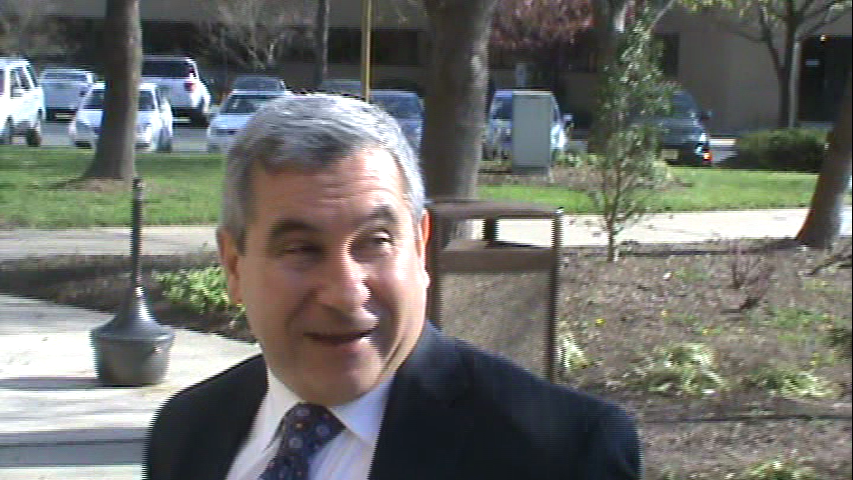
Mario Apuzzo walks toward the Office of Administrative Law with his two clients. Photo: CNAV.
The three judges seemed ignorant of the Constitution, especially what it says about how the United States elects Presidents. Article II, Section 1, Paragraph 2 begins:
Each State shall appoint, in such Manner as the Legislature thereof may direct, a Number of Electors, equal to the whole Number of Senators and Representatives to which the State may be entitled in the Congress: but no Senator or Representative, or Person holding an Office of Trust or Profit under the United States, shall be appointed an Elector.
Judge Fischer asked Apuzzo about “chaos” arising from having each State decide who should appear on a ballot. But the Constitution clearly says that States decide whom to send to the Electoral College.
Furthermore, Fischer seemed to think that the Electoral College, as a whole, had the authority to decide who is eligible and who is not. But the Constitution also says that the Electoral College never meets as a body. Instead, each set of Electors meet in their own States, mark their ballots, seal them, and send them to Congress. The Vice-President then opens them in front of Congress in early January.
And, as Apuzzo tried to tell the court, Presidential Electors are pledged to vote for named candidates for President and Vice-President. Indeed, no voter ever knows the name of a candidate for the post of Presidential Elector. The judges reminded Apuzzo that the pledging or binding of Presidential Electors was not an issue at bar. (Twenty-four States legally bind Presidential Electors, though no State has ever punished a “faithless Elector.” New Jersey is not one of those States.)
Activsts react
A handful of Tea Party activists sat through the hearing. All expected the court to affirm Masin’s holdings. They cited the seeming boredom of the judges, and the questions that Judges Fischer and Carchman asked. (Judge Baxter kept silent throughout the hearing.)
“They just said that New Jersey is no longer a sovereign State!” said Bob and Linda Gordon. Paul Draper, of Wall Township, agreed:
What Federal law trumps State law, or State courts? Do they even know that the Constitution gives States the right to run elections in this country?
Draper is correct. Article I of the Constitution gives States the right to run elections for US congressmen. (Amendment XVII gives States the right to run Senate elections.) Article II (see above) gives States the right to appoint Presidential Electors, except that States may not appoint sitting Senators, Representatives, or federal officers.
Nick Purpura, the lead plaintiff in the case, expressed similar outrage.
The judicial ignorance on display in that courtroom is a prime example of why we need judicial reform!
Apuzzo refused comment until the court actually decides. Neither man speculated on whether they would appeal to the Supreme Court of New Jersey.
Related:
- Posse on warpath
- Arpaio wants proof
- Public appeal hearing
- Kenyan born Obama narrative
- Arpaio won’t quit
- Birth settled?
- Arpaio posse in Hawaii
- New Jersey appeal
- Reliability
- Kenya question
- $2 million
- Media pressure
- Natural-born citizen
- Obama eligibility: NJ ALJ makes new law
- Obama eligibility: NJ ALJ ducks issues
- Obama eligibility witnesses: Clinton campaign
- Obama eligibility challenge in New Jersey
- Obama: who is he?
- Obama birth certificate details
- Obama birth certificate petition
- Obama eligibility battle in Arizona legislature
- Obama birth certificate still suspect
- Obama born in Kenya?
- Presidential succession crisis
- Does anybody really know what time it is?
- Obama birth certificate investigation
- Obama birth certificate fraud analysis
- Obama birth certificate fraud
- Natural born citizen: what that means
- Obama eligibility: reactions to ruling
- Obama eligibility: flawed ruling
- Obama eligibility challenges multiply
- Obama eligibility challenges explode
- Obama eligibility challenges go forward
- Obama birth certificate does not satisfy
- Obama releases official-looking birth certificate
[amazon_carousel widget_type=”ASINList” width=”500″ height=”250″ title=”” market_place=”US” shuffle_products=”True” show_border=”False” asin=”B00375LOEG, 0451947673, 0800733940, 0062073303, 1595230734, 1936218003, 0981559662, 1935071874, 1932172378, 1936488299″ /]


Terry A. Hurlbut has been a student of politics, philosophy, and science for more than 35 years. He is a graduate of Yale College and has served as a physician-level laboratory administrator in a 250-bed community hospital. He also is a serious student of the Bible, is conversant in its two primary original languages, and has followed the creation-science movement closely since 1993.







-
 Human Interest5 days ago
Idaho prepares to defend its abortion ban
-

 Education2 days ago
‘Grading for Equity’: Promoting Students by Banning Grades of Zero and Leaving No Class Cut-Ups Behind
-

 Civilization4 days ago
Earth Day Should Celebrate U.S. Progress & Innovation
-
 Family2 days ago
Idaho defends against abortion mandate
-
 Civilization3 days ago
Newsom plays silly abortion politics
-
 Education4 days ago
The Intifada Comes to America. Now What?
-

 Civilization4 days ago
Earth Day – part of cultural Marxism
-

 Civilization3 days ago
Waste of the Day: China Still Owes Over $1 Trillion to American Bondholders
It’s almost hard to believe that you can’t find a single judge to agree with the birthers. It would be immediately appealed, I just can’t believe someone hasn’t done it yet. There have to be crazy judges out there.
I am not sure why you say that this was an embarrassment for the court. It seems more of an embarrassment for the appellants. Surely you are not suggesting to your readers that the court should be embarrassed based on the “legal analysis” of a few tea partiers in the audience?
I suggest to you that the court embarrassed itself by suggesting that the United States Constitution said differently from how it reads. What part of “Each State shall appoint, in such manner as the legislature thereof may direct, a number of Electors…” did you miss? Because the court missed it, too.
That, and the bored and even disheveled physical appearances of the learned judges, are the embarrassments.
How exactly does a provision stating the number of people a state is allowed to select as Electors have any baring on who appears on the Presidential ballot? It has nothing to do with the states deciding who appears.
Unless you’d care to explain in detail just what it is the courts missed. Although I feel it is you engaging in a handy misreading of the Constitution.
I’m still amazed at how dumb court officials become, every time they rule against the birthers. After all, it can’t be because the birthers are utterly, absolutely wrong and have no case.
Still, I suppose WND needs something to attract readers.
The Constitution says:
It does not say,
But that is how you are (mis)construing the Constitution. And it is how the disheveled Judge Fisher misconstrued the Constitution also.
You do understand the difference between electors and candidates on the ballot don’t you Terry?
Incompetent, irrelevant, and immaterial. Any State legislature can tell the Two Parties to take a hike whenever they d__n well please. You will not repeat not find the word “party” in the Constitution, that means anything like the Democratic Party or the Republican Party.
I agree with Terry. The states appoint electors, so it logically follows that the state can dictate who is eligible to be elected, because the constitution.
I agree that the judges were disinterested, but I don’t think you do. I believe you meant uninterested, given the context.
You keep mentioning the question about Chaos, but it reveals your own ignorance. Concerns about a precident leading to chaos and disorder have been a part of legal decision making as long as our style of judicial system has been in existence. All through American history you can see judges worrying about confusion, panic, and disorder as a result of a decision.
You stress so much the role of the constitution, ignoring any role of state laws that might lead to the judicial decisions, but you also mention state law when you think it plays in your favor. Specifically I’m thinking about the electors being bound, no where in the constitution does it say that the electors are bound, it is a matter of state law that they are.
I pointed out that electors are pledged. I never said that I considered that appropriate.
Given that elector is defined as:
1. (Government, Politics & Diplomacy) someone who is eligible to vote in the election of a government
2. (Government, Politics & Diplomacy) (often capital) a member of the US electoral college
You still haven’t explained how that translates to states deciding who is on the ballot or not. Choose electors does not equal choosing who appears on the ballot.
Is it possible you don’t understand the meaning of the word?
I think it’s taken on an almost religious aspect with you. It must be like that, because your entire belief system needs it to be like that (a bit like the Flood really).
There is absolutely no correlation between what the Constittion says, and what you want it to say.
Well, now, to whom do you think the Constitution gives the authority to decide for whom Presidential Electors shall vote? To the Electors themselves!
Ballot placement in elections of Presidential Electors is up to the State government. Under the Constitution, the federal government may not interfere. That logically follows from “each State shall appoint, in such manner as the legislature thereof may direct, a number of Electors.”
The one role that the federal government has, in the appointment of any Presidential electors, is in the appointment of the Electoral College delegation for the District of Columbia. “The District…shall appoint, in such manner as Congress may direct, a number of Electors…”
National Party rules are completely extra-legal, and certainly extra-Constitutional. The only reasons that State legislators follow them is that the members of those legislatures are also members of Parties.
If totally unaffiliated legislators gained a majority in any legislature in the next State legislative election, then on the day that their next term began, they could throw the National Parties over completely. They then could change their election laws so that Electors would have to run in their own names, not the names of any National Party candidates. They could run either at-large, or within Congressional districts, or a combination of both, or even in special Electoral College districts of their own devising. They could even set up machines for write-in campaigns, something that today is useless in elections of Presidential Electors. And the National Parties with have no standing, no cause of action, and no recourse.
To the matter at hand: States, and only States, are the final authority in how to set up, run, and certify elections of Presidential Electors, or primary elections of President or Vice-President. States run popular primaries only as a courtesy. (In Iowa and many other States, State governments do not run primaries; instead, State Parties set up caucuses.) The Appellate Division made a profound error in according Constitutional status to National Parties when the Constitution does not mention them at all.
wow… that is probably the most liberal interpretation of the Constitution I’ve ever seen. So because a state can appoint people to the Electoral College, it can decide who they vote for?
But I thought that the entire state’s electoral college votes go to the winner of the state, so it’s actually immaterial who they want to vote for. Their votes are dependent on who the majority in the state vote for.
And the EC has no say in who the people of the state can vote for.
Still, it’s fun to watch the birthers grasp at ever-more ridiculous straws, while the lawyers get rich.
The one single point that you missed, is that each State set its laws up that way, beginning with the Election of 1800. And any State may go back to the system of uncommitted, own-conscience-voting Electors that prevailed in the Election of 1789, any time it pleases.
The first State to declare that Electors shall run in their own names, and vote their consciences (or whatever slogan they campaign on), may at that point count its legislators among this country’s heroes.
You have a pretty good understanding of how things work. But you have no clue as to who set that up, and how. And you never imagined that just one State could throw a monkeywrench into the two-party system any time it pleased.
Did you even know that the State of Main does not choose all its Electors at-large? It chooses two Electors at-large, and one Elector in each of its two Congressional districts. Usually the two districts end up voting in synchrony. But that does not have to be the case. Main could split its Electoral College delegations three-to-one, or even two-to-two, any time the voters pleased.
That’s all well and fine. But we’re still talking electors here. They have no say in who appears on the ballot. Outside of the original definition, which states that States may appoint Electors, where exactly does it say that they appoint who is on the ballot?
Let’s use a practical example. When Virginia didn’t allow Gingrich on their ballot, was that because in the Constitution it says that their Electors can’t have Gingrich on the ballot, because they don’t like him? Or was it because he applied too late?
The fact remains, you cannot leave who appears and who doesn’t appear on the ballot up to some sort of weird popularity test. That is what the ballot is for. It’s no wonder the judges appeared disinterested and tired.
“And any State may go back to the system of uncommitted, own-conscience-voting Electors that prevailed in the Election of 1789, any time it pleases.”
You mean the system where only white men, who owned property, could vote?
The Constitution says that States may appoint Electors any old way that their own legislators tell them to appoint Electors.
If any legislature wants to break ranks with the two-party system, then that is the legislature’s business.
And saying whose name appears on the ballot, is also the State legislature’s business.
Not Congress’ (except in the DC case). Not the federal judiciary’s. The State legislature’s. So who shall appear on the ballot, is a matter of State law and only State law.
Those three judges embarrassed themselves by adding to the Federal Constitution a power that Congress does not have, and taking away from the Constitution a specific declaration of a power that the States have.
And in case you’re still looking for a specific statement about ballot placement: in addition to “in such manner as the legislature thereof may direct,” I cite the Tenth Amendment: “Reserved to the States.”
I see no reference to ballots in the Tenth Amendment, but I’ll carry on reading. You still haven’t explained how a law enabling a state to appoint members of the EC suddenly also refers to the state setting up the ballot.
“in such manner as the legislature thereof may direct” is a very handy vague phrase.
Now, let me apply Occam’s Razor to all this. Between the NJ case, Sheriff Joe and Taitz’s mob, there have been goodness knows how many court cases, investigations, requests for information, etc.
All of which have resulted in nada, zip, zilch.
And yet, you somehow think it’s the courts’ fault.
[…] Judicial embarrassment […]
[…] Judicial embarrassment […]
[…] Judicial embarrassment […]