
Creation Corner
Creation Day 1: Light

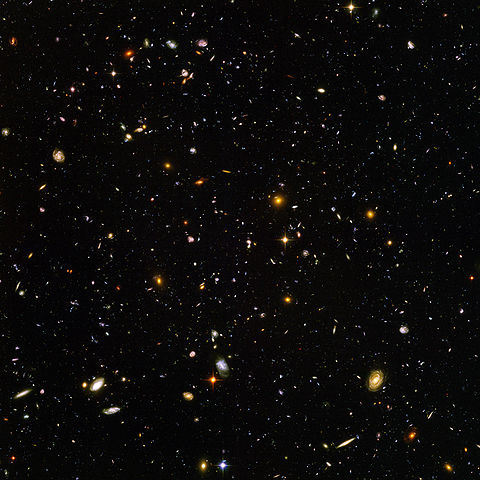
On Creation Day One, God said, “Let there be light.” Where did the light come from? Answer: it came from new matter, and it’s still here.
The Literal Creation Day Problem
Every creation day is a literal day, not much longer than a modern day. (At creation, a year was probably as long as the current year and had 360 days exactly.) The Hebrew word yowm (יום), from a root meaning “hot,” always means a regular day wherever it appears, or else day as opposed to night, or how far one can travel in a day. (A sabbath day’s journey is how far a man can walk.)
Evolution advocates sometimes inflate a creation day to millions, or hundreds of millions, of years. For an atheistic evolutionist, this poses no problem. As an atheist, he rejects the Bible out-of-hand. But a theistic evoloutionist must explain how and why God created plants (Creation Day Three) a full two “ages” before He created sea life and birds (Creation Day Five).
But creation advocates have a problem, too. God did not form the Sun and Moon until Creation Day Four. So when God said, “Let there be light,” and there was light (Genesis 1:3), where did it come from? How and when did God separate light from darkness? How did He set up a day-night cycle from the beginning, three days before He made the Sun?
Details to explain
To explain Creation Day One, one must explain these events, that took place in this order:
- God created light.
- God separated light from darkness.
- An evening and a morning occurred to mark the first day.
And furthermore, this day-night cycle continued for two more Creation Days until God made the Sun and Moon.
This sequence needs a concentrated, on-one-side light source, or lamp, to appear at Step 2 above and continue to Creation Day Four. The Sun is, of course, the permanent lamp that gives light to one side of the spinning earth today.
Conventional explanations
Most creation apologists (as distinct from creation investigators) ignore the problem. God did not need a single lamp on Creation Days One through Three, because God was that Lamp. (See four typical examples of such apologies.) Any evolution advocate will say at once, and correctly, that this begs the question. Why did God bother with the Sun, if He already had a good lamp (or was the Lamp) for the earth? Furthermore, this multiples miracles. If the Bible directly attests to a miracle, one may invoke it. If not, not.
Jonathan Sarfati of Creation Ministries International showed the problem that theistic evolutionists, or “progressive creationists,” have. They explain Creation Day Four by saying that a very dense overcast suddenly resolved on that day and revealed the Sun. Sarfati thus firmly holds that God created the Sun on Creation Day Four and not before then. But he still does not say what sort of lamp God made on Creation Day One.
An engineer speaks
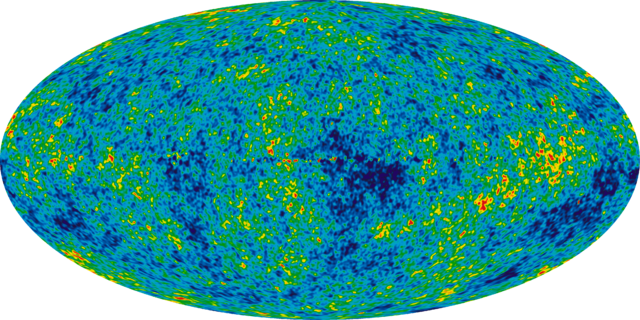
The Wilkinson Microwave Anisotropy Probe map. Photo: NASA
Most will better recognize Dr. Walter T. Brown for his Hydroplate Theory of the Global Flood. But Brown did not ignore the early creation of the universe. He applied himself to that with the same ruthless economy of miracles that he uses in all his work.
To answer the question, “What was the light on Creation Day One?” he points to only one miracle: creation itself. Before light came to be, the earth came to be, formless and empty. In short, the earth, and all the other matter for all the other objects in the universe, came to be as just so many elementary particles. Most of these would be protons, neutrons, and electrons. As soon as these particles appeared, the four elementary forces known to physics would act on them at once:
- The strong force.
- The weak force.
- Electro-magnetism.
- Gravity.
The first two forces would pull protons and neutrons together to form atoms. Electro-magnetism would make the electrons fall into place. Finally, gravity would form a large object, i.e. the earth. And as the electrons fell into place, they would give off light. That was the light of Creation Day One, Step 1 above.
[ezadsense midpost]
This light would at first shine everywhere, from every direction. The light from earth’s forming would go out in less than a second. But light would then fall on earth from the surrounding matter. But before the day was over, it would fall on the earth from further-distant matter. This matter would not distribute itself uniformly in the sky. Most of it would be on one side. And at this time, the light would be “hot,” because the universe had not yet stretched to its present extent. So for three days, the light shone more from one side than the other. This was the lamp that set up the day-night cycle on Creation Day One.
By Creation Day Three, the light would become uniform, because other matter on the “night” side would start reflecting it. But on or before Creation Day Four, the universe would stretch out. This would cool the ambient light in the universe to its present very cold level: 2.73 K, not much above absolute zero.
Where is this light?
This light persists today as the Cosmic Microwave Background, or CMB. Proponents of the Big Bang theory assumed that a large amount of background radiation stopped the first atoms from fusing together after they had produced hydrogen and helium. Without this very hot light, the universe would have far more heavier elements in it than it does today.
But the CMB presents another problem. Why is it so smooth? Brown reports that, as long as 25 years after discovering it, scientists could find no variation in its intensity from one part of the sky to another. The CMB does vary, but thus far only to one part in a hundred thousand. That’s not even enough variation to form a galaxy, let alone the local groups, clusters and superclusters that astronomers see today.
According to Brown, conventional observers know this. Ivars Peterson, in Science News (1990), said:
But this uniformity [in the CMB] is difficult to reconcile with the obvious clumping of matter into galaxies, clusters of galaxies and even larger features extending across vast regions of the universe, such as “walls” and “bubbles.”
M. Mitchell Waldrop, writing in Science (13 November 1987), said this even earlier:
The theorists know of no way such a monster [a massive accumulation of galaxies, called the Great Wall] could have condensed in the time available since the Big Bang, especially considering that the 2.7 K background radiation reveals a universe that was very homogeneous in the beginning.
Are “Great Walls of Galaxies” recent objects only? Not so. The Hubble Space Telescope has found large objects like these at the farthest reaches of the universe. By any understanding of cosmology, these farthest reaches are also the earliest parts. In short, God made the universe that way from the beginning. Yet the CMB is still uniform.
Conclusion
The first great lamp, that lit the earth from Creation Day One through Three, is not a separate miracle. It is a natural consequence of the miracle of creation itself. And that light very likely is still apparent, as a phenomenon that astronomers expected to see, but still does not look as they expected it to look.
[amazon_carousel widget_type=”ASINList” width=”500″ height=”250″ title=”” market_place=”US” shuffle_products=”True” show_border=”False” asin=”0890512760, 1878026097, 0875523382, 0743290313, 0890514119, 0890514410, 0932766412, 0061472794, 0895262002, 0685459039″ /]
[ezadsense leadout]

Terry A. Hurlbut has been a student of politics, philosophy, and science for more than 35 years. He is a graduate of Yale College and has served as a physician-level laboratory administrator in a 250-bed community hospital. He also is a serious student of the Bible, is conversant in its two primary original languages, and has followed the creation-science movement closely since 1993.












-

 Executive4 days ago
The Hunters Have Now Become The Hunted: Their Cruelties Are Swelling The Ranks Of The People Worldwide!
-

 Clergy3 days ago
Why Do The American People Let The Corrupt Media & Politicians Set The Propaganda Narrative – Speak On Their Behalf
-

 Constitution4 days ago
CHAPTER 9: Norman Dodd Interview Space Is No Longer the Final Frontier––Reality Is [upcoming release April 2024]
-

 Entertainment Today4 days ago
Civil War (2024) – an incomplete prediction
-
![CHAPTER 10: Objective Reality Is Required for a Free Society Space Is No Longer the Final Frontier—Reality Is [upcoming release May 2024]](https://cnav.news/wp-content/uploads/2024/04/Objective-reality-v-acceptance-400x240.png)
![CHAPTER 10: Objective Reality Is Required for a Free Society Space Is No Longer the Final Frontier—Reality Is [upcoming release May 2024]](https://cnav.news/wp-content/uploads/2024/04/Objective-reality-v-acceptance-80x80.png) Education3 days ago
Education3 days agoCHAPTER 10: Objective Reality Is Required for a Free Society Space Is No Longer the Final Frontier—Reality Is [upcoming release May 2024]
-

 Human Interest3 days ago
Idaho prepares to defend its abortion ban
-

 Executive5 days ago
National Security Implications of Baltimore Bridge Catastrophe
-

 Executive5 days ago
California Dems Tout Ties to Criminal Leniency Group
If I may, I’d like to offer two other possible, and simple, possibilities.
1) Evening and Morning, prior to creation of the Sun and Moon, could simply define time-scale. So that we would know that the events of the first day happened during the time of a normal day, regardless of the absence of a Sun.
2) There is a greater theological truth at play, in looking at the authority of the events in Genesis 1. God is the Creator of all things. God could make light come from any source he chooses. There could have just as easily have been a light day and a dark night, even before He set the Sun to “rule” the day. It’s only because God made things work the way they do that our daylight comes from the Sun and light from the stars and reflected light from the Moon, etc.
Whether or not there was or was not an actual light day and dark night on the first day, the truth of the passage remains. God is the creator. He made the rules of how things work. The events of the first day happened during a standard day.
Genesis 1:14 – “And God said, “Let there be lights in the vault of the sky to separate the day from the night, and let them serve as signs to mark sacred times, and days and years,” 15 and let them be lights in the vault of the sky to give light on the earth.” And it was so. 16 God made two great lights—the greater light to govern the day and the lesser light to govern the night. He also made the stars. 17 God set them in the vault of the sky to give light on the earth, 18 to govern the day and the night, and to separate light from darkness. And God saw that it was good. 19 And there was evening, and there was morning—the fourth day.
Why did God make light twice? What was wrong with the first light?
Also, if the Moon is there to govern the night, why would God also have it be visible in the daylight sometimes?
The book of genesis has more plotholes than the matrix trilogy.
Stay tuned for the Creation Day Four article, and you’ll get the straight dope. In any event, the first lamp was only temporary. It wouldn’t last. If you read the article, you’ll see that the light persists, but is much “cooler” than it was. In fact it’s the same as the CMB.
Assuming that the light was a byproduct of the initial creative forces, as this article does, the first creation of light was temporary, and the sun was created to act as the permanent source of light.
Concerning the moon, just because the moon was created to provide light at night doesn’t mean it is restricted to only being visible at night. Its being visible at certain times of day does not retract from its ability to fulfill its created purpose. You might as well be asking why the sun provides light to the other planets of our solar system when the purpose of its creation was to provide light to Earth.
“Its being visible at certain times of day does not retract from its ability to fulfill its created purpose.”
Tell me this: is the moon ALWAYS visible at night? No it’s not, is it? That’s because it doesn’t have a function of providing light at night; that it sometimes does so is just an accident of its surface composition.
Look, you’re arguing about the implications of words spoken, and eventually written, by people who had no sophisticated understanding of the vast dimensions and great age of the cosmos from which we all evolved.
It really isn’t worth arguing about this. Nobody takes it seriously any more. It’s the best they could do at the time, but it’s still rubbish.
Conventional cosmologists can’t explain the CMB any better than this, so your argument is rather weak. In fact they needed something like the CMB to make their theory fit current observation. And then when they found the CMB, it was too smooth to account for all the objects everyone sees, and still is.
And if it isn’t worth arguing about, why did you post a comment?
“Conventional cosmologists can’t explain the CMB any better than this, so your argument is rather weak.”
This is a puzzling statement seeing as the existence of the CMB was predicted well before it was detected and mapped. The underlying cause is clearly documented (and the whole CMB detection story is a good read).
Except for one thing: they can’t explain the smoothness of the CMB. It would have to vary a lot more than has been shown to explain the Great Wall of Galaxies at the universe’ edge, for example.
You can’t defend rubbishy theories by pointing to holes you think exist in others. We already know that the accounts in Genesis are woefully inadequate–and of course that’s okay, nobody would expect anything other of a cosmology written by people long ago without our hard-won modern understanding of the universe.
But that’s the problem: what you call the “hard-won” (won against whom?) “modern understanding” is really a modern misconception of the universe and misconstruction of the available evidence. Besides which, if you really read the article all the way through, you’d know that I did set forth a theory that takes strength from a, dare I say, modern understanding of the “inner space” of the subatomic world.
[…] Creation Day 1: Light […]
[…] shaping of the crust in the overall sequence. Several commenters, including some on this site, have asked: Why did God make light twice? What was wrong with the first […]
My phrase “hard won knowledge”, by the way, refers to the fact that it wasn’t presented to us in a book or on tablets of stone, but had to be deduced from thousands of years of observation and experiment.
I have my own idea why you might think that hard won knowledge to be “misconstruction of evidence.” As I remarked on another thread, these “creation scientists” you look to are not engaged in science at all, for they all adhere to a dogma agreed in advance. Unlike science, this dogma cannot be rejected when the evidence supports a superior but less comforting hypothesis. Their work amounts to apologetics.
Experiment? Are you serious? We’re talking history here. What experiments do uniformitarians have? And “superior hypothesis”? This is why one can indeed defend one argument by weakening another in this context. The Big Bang is definitely inferior to the model that Brown presents.
You’ll have noted by now that the Big Bang is the current working model used by modern cosmologists, while Brown’s model is all but unknown outside his website and those of a few competing fringe practitioners.
You haven’t challenged the role of observation, at least. As for experiment, the earth sciences have that, too though I don’t blame you for being unaware of the field of experimental geology.
Like any physical process, geological processes taking vast amounts of time may yet be physically modelled in the laboratory. From the models come predictions that, combined with observation, tell us how faithful our models are.
The most important tool in geology is observation, but such experiments have their place.
You would do well to read Dr. Brown’s book and see the sort of observational and even experimental evidence he has at his own disposal.
And arguments from authority don’t impress me. History is replete with example after example of “current working models” crashing and burning beyond recognition in the face of attacks by men considered “cranks” at first.
“arguments from authority don’t impress me”
So why do you constantly quote Walt Brown, a man who will neither publish his work nor step up for his own debate challenge?
Your continued misrepresentations of fact about Walt Brown do not impress me.
I cite him because he has set forth a detailed explanation of the creation of the world with which I fully agree, after close examination. I cite him because the law of the United States (viz. the Copyright Act of 1973) and the principles of journalistic ethics require me to cite anyone who comes up with an idea that I quote, whether that idea is a detailed model for the planet’s coming to be, or an apt and pithy line. I don’t claim that “because he says it, it must be right.”
Whereas you do claim that because “the great numbers of his peers” say a thing, that thing must be right.
An argument from authority assumes without warrant that the authority cited is infallible. The only Authority that rates that treatment is God Himself.
And an argument from numbers assumes without warrant that the greatest number of people will always speak the truth. Indeed, the argumentum a numeris and argumentum a multitudine both define truth as “that with which the greatest number, or the members of the largest crowd, agree.” That is where you stand. I am the one speaking truth to “authority,” and to the crowd.
If you don’t like it, quit wasting my time on this comment space and take your pettifogging complaints elsewhere.
“Whereas you do claim that because “the great numbers of his peers” say a thing, that thing must be right.”
Actually I claim no such thing. What I am saying is that the evidence and the known laws of science all point in one direction, and it’s not the direction Walt Brown has wandered off in. Brown is simply wrong; his “theory” is laughable, which is no doubt why he refuses to submit it for publication and why I’ve been waiting for over five weeks for him to return my last email about his debate challenge.
What you call “the evidence” and “the known laws of science” are nothing more than the pronouncements of a few Big Names with Clout, that have a big crowd of followers.
“What you call “the evidence” and “the known laws of science” are nothing more than the pronouncements of a few Big Names with Clout”
No, they’re the evidence and the known laws of science. If I say that masses exert an attractive force on each other I am making a statement backed up by evidence (observation of what happens when I drop puppies off a cliff) and the known laws of science (described by various theories of gravity.) To say that it’s nothing more than the pronouncement of a few big names – in this case Isaac Newton and Albert Einsten – is absurd.
Nevertheless: we deal here with concepts like “dark matter” and “dark energy” that are nothing more than fudges to protect a cosmology that is riddled with error. The Emperor has no clothes on. And by the way: you’re trying to apply a strictly local observation to an event affecting the entire cosmos. It doesn’t work that way. Indeed, Einstein showed that Newton’s understanding was incomplete.
“concepts like “dark matter” and “dark energy” that are nothing more than fudges to protect a cosmology that is riddled with error.”
Not at all. We KNOW that dark matter exists; we just don’t know exactly what it is yet, although possible candidates have been observed in several labs over the past few months.
“The Emperor has no clothes on.”
Just because there’s a few things we don’t quite understand yet? Sorry, that’s just silly.
“you’re trying to apply a strictly local observation to an event affecting the entire cosmos.”
Masses exert an attractive force on each other throughout the entire cosmos. So no, I’m not.
“Einstein showed that Newton’s understanding was incomplete.”
Incomplete, yes. So what? Incomplete as it is, it’s good enough to launch spacecraft with enough accuracy to fly past planets billions of miles away.
I dispute the existence of “dark matter.” I defy you to prove its existence. You have never handled it, nor met the astronomer who has. I’ve read about all four “candidates” for its existence, including MAChOs, WIMPs, Deep Black Holes, and “Axions” (whoever came up with that name, messed with a registered trademark, by the way). “Dark matter” is a mathematical fudge. In simpler terms, it is pure bunk.
And I don’t care how many people pretend that it exists.
“I dispute the existence of “dark matter.” I defy you to prove its existence.”
I don’t much care if you dispute it or not. Its existence has been thoroughly proven by the fact that galaxies exist and take the form they do. There is additional matter in there which hasn’t been detected yet; the only alternative is that gravity doesn’t work at macroscopic scales in the way described by the various theories, and we have REPEATEDLY confirmed that it DOES.
“You have never handled it”
Nope. On the other hand I’ve never handled a neutron star either, and they certainly exist. Did you have a point?
“nor met the astronomer who has.”
Ditto. Irrelevant.
“I’ve read about all four “candidates” for its existence, including MAChOs, WIMPs, Deep Black Holes, and “Axions””
That’s ONLY four. There are others, including dark atoms. Lots of exciting stuff has happened recently and it’s likely that there will be breakthroughs soon. It really is a pity that your prejudices won’t let you share that excitement.
Well, I do not much care whether you, in particular (or any one person, in particular) accept the Hydroplate Theory or not, or accept the cosmological outlines that I have laid out, or not. I find Brown’s explanations eminently elegant and logical. And I find the conventional models of “dark matter” unsatisfactory.
A “dark atom”? Mr. Mason, now you’re talking the sort of alternate reality that was a staple of television productions like Space: 1999. And that was one of the least egregious of the science-fiction television productions, American and British, of the Sixties and Seventies. I go further: the writers and script consultants for Space: 1999 did a better job of explaining the alternate realities with which the officers and crew of “Moon Base Alpha” had to deal, than conventional astronomers have done of describing “dark matter.”
“Well, I do not much care whether you, in particular (or any one person, in particular) accept the Hydroplate Theory”
The problem is, of course, that practically NOBODY accepts the hydroplate “theory,” because it has gaping holes in it and doesn’t stand up to such basic facts as the specific heat capacity of water. That’s probably why Brown refuses to submit it for publication or take part in a debate on it.
“A “dark atom”? Mr. Mason, now you’re talking the sort of alternate reality that was a staple of television productions like Space: 1999.”
No, I’m talking about atoms that don’t interact with the EM spectrum in a way we currently understand. There is some evidence for these atoms.
“than conventional astronomers have done of describing “dark matter.””
Except nobody’s actually tried describing black matter, becase WE DON’T KNOW WHAT IT IS YET. The farthest anyone has gone is hypothesising what it MIGHT be. However it’s definitely there, and anyone denying that is denying the existence of gravity.
We don’t know what it is, but we’ll take it over a much simpler explanation. Have you any idea how illogical that sounds?
“We don’t know what it is, but we’ll take it over a much simpler explanation.”
But there ISN’T a much simpler explanation. Any alternative explanation has to account for how gravity works one way in every place we’ve been able to directly test it and a completely different way everywhere else. No explanation can do so. Dark matter IS the simple explanation.
A simpler explanation does exist. I have given it to you. Before you reject it, you must show that it doesn’t fit the facts.
“A simpler explanation does exist. I have given it to you.”
Have you? Where is it then?
In the article, of course. The stretching of space stretched time on earth. The accelerated spin curves of distant galaxies and clusters is like a video played in fast-forward mode. No “dark matter” need be invoked.
“The stretching of space stretched time on earth. The accelerated spin curves of distant galaxies and clusters is like a video played in fast-forward mode.”
That is neither simpler nor an explanation. In fact it’s utter nonsense. You don’t have any evidence for it at all, do you?
Have you evidence for dark matter? “Dark matter” is a competing explanation, and a far more complex one. In fact, I repeat: it gives every appearance of a contrived fudge, as contrived as any fudge meant to justify the premise of a science-fiction drama.
“Have you evidence for dark matter?”
Yes, lots. For starters, if dark matter DOESN’T exist then the whole of Newtonian mechanics and general relativity is wrong. This is not, in fact, the case.
“a far more complex one.”
Why? The only assumption it requires is that a type of particle exists that we haven’t discovered yet. Do you have ANY idea how many assumptions like that have been made and how often the particle in question has later been discovered? Hint: very often indeed.
What you have offered is not evidence. It is merely a rationale. Evidence would be a finding that properly conforms to a prediction. “Dark matter” is not a predictor. It is an after-the-fact fudge.
In fact, general relativity needs an extension. General relativity is not “wrong,” as you put it. It is merely a special case that adequately treats local effects but not cosmic ones. The correct treatment of cosmic effects accounts for all the motions that conventional cosmologists mis-attribute to “dark matter.”
“What you have offered is not evidence. It is merely a rationale.”
No, it’s evidence. Guess what? Science has been here before, when it was discovered that atoms weighed about twice as much as they were supposed to. This was taken as evidence for the existence of neutrons. Guess what was found when science advanced far enough to look inside atomic nuclei? That’s right: neutrons! Using observed mass to infer the existence of so-far undetected types of matter is nothing remarkable and not at all sweet, sticky or anything else characteristic of fudge.
“General relativity is not “wrong,””
I know. You and Brown, apparently, don’t.
“It is merely a special case that adequately treats local effects but not cosmic ones.”
On the contrary. We know that it deals with cosmic effects very well indeed, because through all sorts of methods, such as the effects of gravity on light from extremely distant objects, WE CAN TEST IT.
But general relativity fails when dealing with galaxies and clusters that spin faster than they should. Hence the “dark matter” fudge. A new relativity that encompasses the old and works over the vast distances and time scales of the entire cosmos anticipates those higher spin rates that general relativity does not.
You say that “science has been there before.” Yes, but not to the credit of your side. Conventional astronomers of Einstein’s day came up with a planet named Vulcan (not to be confused with the fictitious planet in the Eridanus constellation), inside the orbit of Mercury but always keeping station on the far side of the sun. They invoked Vulcan to explain a precession in the orbit of Mercury. Of course, the inconvenience of an object inside the orbit of Earth, yet always hiding from Earth on the Sun’s far side so that even the ancients did not observe it, did not matter. But Einstein explained the orbit of Mercury without reference to any inner planet, or any inner asteroid belt (the competing explanation). And so astronomers, realizing their mistake, abandoned their search for Vulcan. (And no modern rocket probe, not even Mariner 10 or MESSENGER, has spotted any such planet or asteroid belt.)
“Dark matter” is the cosmic Vulcan. It has no more evidence to support it than Vulcan had.
How do you reconcile your rejection of dark matter with your touting of an ‘ocean’ of subcrustal water under China? In the hydroplate theory thread you referred to a study of seismographic data which could be interpreted as being consistent with the presence of a large volume of deep hydrated rock underneath the Pacific Rim . You claimed that this supported Brown’s hydroplate theory. But of course no deep drill core struck water; no bathysphere was lowered down a mine shaft into water, no video recordings of water were made. Nobody has handled or studied the purported water in a lab. The water’s existence is inferred based on comparing models of its expected effects on seismic waves (as hydrated rock rather than a discrete body of bulk water, by the way) to actual seismic records. You seem willing to accept this evidence for the subcrustal water under China.
Similarly, dark matter is not directly observed, but its effects on normal matter and light can be indirectly observed. Gravitational lensing observations of colliding galaxy clusters shows that the mass distribution of the colliding system does not match up with the mass distribution of the visible matter, and instead is consistent with a system of combined dark and visible matter of particular properties. You seem unwilling to accept this as evidence for dark matter (I say evidence, not proof).
Why is the existence of the water accepted and the existence of the dark matter rejected?
“Dark matter,” contrary to your fellow traveler’s insistence, violates every law of modern physics. Matter cannot be dark. Every observation that conventional astronomers twist to “demand” “dark matter” is consistent with a far simpler explanation. Not so the Beijing Anomaly. The explanation for that is a lot more complex than simply accepting that the first oceans were two in number, one above the crust and the other beneath it.
Here’s another example; the solar neutrino problem, which unlike dark matter was a genuine problem for astronomers. The detected neutrino flux from the Sun was only a third of that which should have been detected if the Sun is indeed powered by nuclear fusion, instead of gravitational collapse as many “young Sun” idiots proclaim. The solution, which unlike dark matter seemed wildly speculative, was that other types of neutrinos existed. Sure enough, two more types of solar neutrinos were duly found.
Anyway, this is getting dull. Come up with something that doesn’t come from Brown and give me a genuine alternative to dark matter. I’m off to fire up my microscopes and study some cultures. I’ll check back in an hour or so.
“Matter cannot be dark.”
Oh FFS Terry, don’t talk such nonsense. OF COURSE matter can be dark. How bright is matter at absolute zero, eh? How much EM radiation is it emitting? That’s right: none! It’s DARK!
Absolute zero is never reached.
“Absolute zero is never reached.”
Not so far, but it will be, by the entire universe. In any case that’s not a very convincing defence of your statement that “matter cannot be dark.” OF COURSE matter can be dark, where “dark” means “not giving off any radiation we can detect with current instruments.” 50 years ago a man in a camouflaged uniform lying still under a bush was dark matter; now he can be easily detected with a $2,000 set of thermal imaging NVGs. 75 years ago a distant ship at night was dark matter; now any yacht’s radar set can see it. 500 years ago anything with an angular size below the resolution of the human eye was dark matter; now we have telescopes.
And until it does, matter will not go dark.
“And until it does, matter will not go dark.”
FFS. Try reading the rest of my comment, would you? “Dark” simply means that it’s not emitting any radiation that we can currently detect. The threshold and type of radiation that we can detect is not fixed. It changes as SCIENCE – not faith – develops new detectors.
Obscenity aside, you’re the one applying faith here. Faith, or an anti-faith, that someone, someday, will somehow develop some device to see some form of radiation from some type of matter that never emits normal visible light, though every known law says that it should.
“Faith, or an anti-faith, that someone, someday, will somehow develop some device to see some form of radiation from some type of matter that never emits normal visible light”
Like a Heinkel He111 bomber flying towards London at night with its lights switched off? Google “radar” and be amazed.
“though every known law says that it should.”
What law says that matter must emit visible light? Throw a penny down your cellar stairs, then go search for it with the lights off. Tell me how much visible light that penny is emitting, OK?
On a stellar scale, matter ought to be luminous. That bomber you mentioned, by the way, was a designed and built object, not a wild-type object.
“On a stellar scale, matter ought to be luminous.”
Why? Black holes certainly aren’t, are they?
“That bomber you mentioned, by the way, was a designed and built object, not a wild-type object.”
So what? That’s utterly irrelevant. The same radar set can detect a large bird at ranges where it would be below the human eye’s resolution, and therefore invisible, even if it was glowing a cheerful luminous pink.
The trouble is that the kinds of black holes that would produce such spin curves would be far more massive than any previously observed. Black holes aren’t the issue. You earlier spoke of new forms of radiation; now you’re on to black holes. Make up your mind, sir. Which is it?
“The trouble is that the kinds of black holes that would produce such spin curves would be far more massive than any previously observed.”
So what? I only mentioned black holes as an example of something that we couldn’t detect – but now sometimes can – and which caused gravitational effects EXACTLY IN ACCORDANCE WITH GENERAL RELATIVITY.
“You earlier spoke of new forms of radiation”
No, I spoke of previously unobserved types of matter – you know, just like atoms, protons, electrons, neutrons, quarks, antiparticles and neutrinos used to be.
This will be the last time. General relativity predicted black holes. But: it did not predict any of the quantities, or forms of “dark matter” that you describe. Black holes do not explain the spin curves; they would have to be too massive for that, and to exert a lot of other effects that we do not observe. Hence the extension of general relativity, to account for the dilation of time from the stretching of the universe.
What _is_ the simpler explanation for the mismatch between the distribution of the visible matter in a colliding galaxy cluster and the mass of the ‘invisible’, or dark matter, in that same cluster, as demonstrated by gravitational lensing? The phenomenon is consistent with an entity that interacts only by gravity. I don’t believe that any tweak of GR accounts for the same observations. I am not referring to galactic rotation curves, in case that is your understanding of my question.
I still don’t know why you accept the existence of subcrustal water under China when it’s presence can’t be proven by anything other than indirect means. If you accept that the water is there, then there can be varying theories about where it came from (hydroplates vs. subduction of hydrated ocean floor material) but I don’t know why you even accept the proof of its existence, given your skepticism about other indirect techniques like GPS tracking of crustal plates and seismographic models of subduction.
Not gravity alone. Time dilation. Time dilation on earth would appear as time compression from the POV of an Earthly observer looking at a far-flung object.
Hartnett (Starlight, Time and the New Physics, 2007) explains it in detail.
“But general relativity fails when dealing with galaxies and clusters that spin faster than they should.”
No it doesn’t; in fact general relativity tells us that there is matter there which we haven’t observed yet. A large percentage of this matter is in fact nothing more exciting than cold gas and dust, but some is of new types. And sure enough, particle accelerators are starting to see signs of new particles that closely match what astronomers predicted.
“A new relativity that encompasses the old and works over the vast distances and time scales of the entire cosmos”
Not required. GR already does that perfectly well.
“Conventional astronomers of Einstein’s day came up with a planet named Vulcan (not to be confused with the fictitious planet in the Eridanus constellation), inside the orbit of Mercury but always keeping station on the far side of the sun.”
Bollocks. ONE French mathematician came up with that idea; everyone else looked at teh predicted location of the planet, saw nothing, shrugged their shoulders and forgot about it. The mathematician in question died in 1877, before Einstein was even born, and GR explained the orbit of Mercury.
““Dark matter” is the cosmic Vulcan. It has no more evidence to support it than Vulcan had.”
No, it has lots of evidence to support it: millions of galaxies, for a start.
If GR explains the rotation curves perfectly well, why “dark matter” at all?
“If GR explains the rotation curves perfectly well, why “dark matter” at all?”
You seem to be approaching this from the wrong side. GR works just fine at the macro scale; this has been repeatedly tested and confirmed, and is not in any doubt. Astronomers aren’t coming up with dark matter as a fudge to save GR; they have used GR to determine the existence of a so far unknown type of matter, which I might add is far from the first unknown type of matter which has been determined from observations and later found.
That’s right: they are coming up with dark matter as a fudge to save, not so much GR, but their current assumption of applying it on a cosmic scale to validate their Big Bang theory. You deny the proposition, but then merely re-state it in other ways. That’s like saying, “I did not kill this man; I merely accelerated his inevitable end.”
“they are coming up with dark matter as a fudge to save, not so much GR, but their current assumption of applying it on a cosmic scale to validate their Big Bang theory.”
But we KNOW that general relativity applies on a cosmic scale, because WE’VE TESTED IT.
Your tests fail to explain the spin curves. Else why bother with “dark matter” at all?
“Your tests fail to explain the spin curves.”
Either you’re STILL looking at it backwards or you’re being deliberately obtuse. We know that GR works through observations of countless things that have nothing to do with spiral galaxies. Therefore we have enough confidence in it to say that if galaxies aren’t behaving in the way we would expect if we can see all the matter they contain, there must be matter there that we haven’t seen yet. There really isn’t anything remarkable in this. Remember that not so long ago nobody could work out why spiral galaxies existed at all; then supermassive black holes – which are most definitely matter and are as dark as you can possibly get – were discovered.
Your tests fail to explain the spin curves. A theory can work through a whole host of things and still fail on one counterexample. You call yourself a scientist, and you dare contradict that fundamental maxim?
Your tests fail to explain the spin curves. And for that reason alone, your theory requires an extension.
“Your tests fail to explain the spin curves.”
Only if you make the assumption that we can see all the matter in the galaxies. Given that every year we find new things that we couldn’t see previously, that assumption is unjustified.
“And for that reason alone, your theory requires an extension.”
Propose one then. And have the courage to submit it for publication.
And why should I not so assume?
I am not here, by the way, to take credit for someone else’s ideas. See Hartnett JC, Starlight, Time and the New Physics. Order it on-line at Amazon.com, Amazon.co.uk, or some such.
“And why should I not so assume?”
Because assuming that we can see all the matter in a galaxy thousands of parsecs away is either insanely hubristic or just insane.
“See Hartnett JC, Starlight, Time and the New Physics. Order it on-line at Amazon.com, Amazon.co.uk, or some such.”
No actually, I think I’ll just stick to reading proper scientific papers. And Hartnett hasn’t published any that deal with his YEC nonsense, has he?
And assuming something like “dark matter” is not equally insane?
I gave you a reference. You choose to ignore it. Fine. Then this discussion is ended.
Do not attempt to post further or I shall block you.
‘History is replete with example after example of “current working models” crashing and burning beyond recognition in the face of attacks by men considered “cranks” at first.’
Yes, of course. They laughed at Columbus, they laughed at Fulton, they laughed at the Wright Brothers,”, as Sagan said.
But remember, he went on, “they also laughed at Bozo the clown.”
I’m pleased to see that you’ve decided to stop being impressed by appeals to authority. Time to put that silly old bible away, eh?
For anybody who wants to know what actual real working astrophysicists are saying about the Cosmic Microwave Background anisotropy, Wikipedia is a good place to start:
link to en.wikipedia.org
Science: it’s the real thing. Accept no substitute.
“By any understanding of cosmology, these farthest reaches are also the earliest parts.”
Uh no, they’re not. It’s just that we’re seeing them at an earlier date. And the limit of the OBSERVABLE universe is not the same as the edge (if it even has such a thing, which is unlikely) of the ENTIRE universe.
[…] Reprinted from Conservative News and Views. This entry was posted in Apologetics and tagged astronomy, creation, evidence, scientific theory by Terry Hurlbut. Bookmark the permalink. […]
[…] points out the place of the shaping of the crust in the overall sequence. Several commenters have asked: Why did God make light twice? What was wrong with the first […]