
Creation Corner
Desert whales clarified

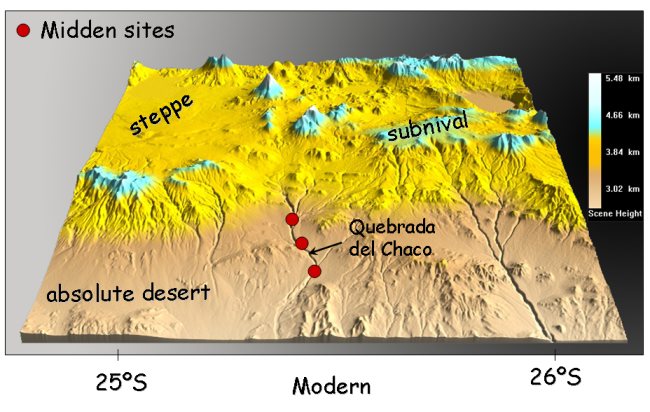
The pod of 80 ancient baleen whales in the Atacama Desert has excited paleontologists everywhere — and caused much controversy here. Herewith a clarification of the desert whales story.
Details of the desert whales
The reports of the desert whales came from the Associated Press, Nature.com, and two other sources. They all agree on these point:
- About eighty ancient whale skeletons are present at the site. They are all baleen whales (suborder Mysticeti). The skeletons are some of the best-preserved specimens that anyone has ever found. More than a quarter of them are intact.
- The site itself is about half a mile inland, in the Atacama Desert, the driest in the world.
- The site holds skeletons of sharks, a now-extinct porpoise (“dolphin”), and seals, in addition to the whales. (The dolphin is especially remarkable for its two walrus-like tusks.) Other scientists have earlier found birds elsewhere in the Atacama Desert.
But the four articles do not seem to agree on the location. Three names of towns and villages appear: Caldera, Copiapó, and Bahia Inglesa. Of these, Copiapó is actually forty miles further inland than the other two, and at the highest elevation of the three.
Another reader, whom your editor knows personally and who has earned my respect, identified the likely scene by examining the published AP photographs. Those that do not simply look straight down on the desert whales, look toward the nearby Highway 5 or toward an obvious body of water. That, plus the AP statement that the desert whales are about a kilometer inland, means that the desert whales are not near Copiapó. Why AP captioned some of their photographs and used as a reference a town forty miles distant from the find, when two other towns were much closer, your editor will not speculate.
Caldera and Bahia Inglesa are both on the beach. But the site is not on the beach, but is a kilometer away from it. Other readers have suggested that the desert whales are at an elevation of 150 feet above sea (and beach) level.
Riddles about the desert whales
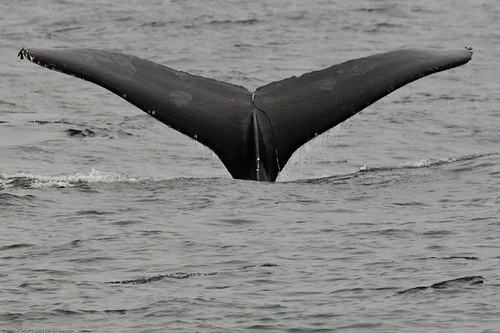
A humpback whale shows its tail off the California coast. Humpbacks are one of the best-known members of the baleen order, the same as the desert whales of the Atacama Desert. Photo: Mike Baird, CC BY 2.0 Generic License.
So the elevation itself would not preclude a mass stranding from the ocean. But at least two other facts about the desert whales, and other animals found near them and elsewhere in the Atacama Desert, are hard to explain by ordinary mass stranding. And this does look like a mass stranding. How eighty whales could strand themselves all in one spot over thousands of years or more is almost inexplicable.
- The desert whales are baleen whales, not the toothed whales (Odontoceti) that one sees in beaching or mass stranding incidents. So these whales did not beach themselves, as the AP article suggested.
- The other fossils in the Atacama Desert present a worse problem. Why would birds (one of which had the wingspan of a large condor, by one account) die suddenly in an earthquake or a tsunami? An earthquake disturbs the local electric field; a bird would sense this at once and fly away. Animals are equally sensitive to an approaching tsunami. And a condor-like bird should certainly have been able to fly away from that.
Conclusion
Thus several facts make the desert whales easier to explain by a generalized catastrophe, or cataclysm, than by multiple events over thousands of years, or millions. The elevation of the site is not one of them.
Your editor apologizes for misreading the initial clues, and thanks those readers who took time to furnish those clues, analyze them, and point them out.

Terry A. Hurlbut has been a student of politics, philosophy, and science for more than 35 years. He is a graduate of Yale College and has served as a physician-level laboratory administrator in a 250-bed community hospital. He also is a serious student of the Bible, is conversant in its two primary original languages, and has followed the creation-science movement closely since 1993.












-

 Civilization3 days ago
Rafah incursion under way
-

 Guest Columns4 days ago
Trump Is a Rorschach Test for the Body Politic
-

 Judicial4 days ago
Jack Ryan’s Mission To Free the Real Estate Market
-

 Education3 days ago
‘Knuckleheads, Ego-Trippers and Extremists’
-
 Executive4 days ago
Waste of the Day: New Ships Could Cost Billions More Than Navy Expects
-

 Education4 days ago
The Great College Suckerpunch
-

 Civilization3 days ago
Strengthening Our Beleaguered Military Starts With a Maritime Overhaul
-

 Executive1 day ago
COVID narrative – retraction begins
Nope, baleen whales do get stranded as well, just less frequently. For example: link to noaanews.noaa.gov
Birds? No problem. Many birds eat carrion. 80 dead whales, I would suggest, makes rather a lot of carrion. Scavengers and small predators are often found fossilised near dead prey species.
A lot less frequently, I would say. And too rarely to explain eighty of them beaching at once.
As to the birds: just how do you explain fossilization of birds, anyway? What could have caught those birds by surprise like that? And carrion? Those whales are a bit too well preserved for that.
Duh? Just because something happens rarely doesn’t mean it doesn’t happen.
How do I explain fossilisation of birds? The same way as I explain fossilisation of anything else with a skeleton. There are plenty of bird fossils. Who says they were caught by surprise? Given the amount of carrion represented by 80 dead whales (and feeding by condor-sized birds wouldn’t noticeably damage a baleen whale skeleton, BTW) they could practically have died of old age. That’s not even allowing for fights among scavengers, poisoning from decaying meat or any of the other things that kill birds in huge numbers.
Fossilization happens only one way: when something gets buried alive, and fast. That requires surprise.
And your first statement is the prize example of insisting on a rarer-than-hen’s-teeth event just because it fits your narrative. You evolutionists refuse to reject the null hypothesis for the same reason.
Utter nonsense. Fossilisation does not require rapid burial and it CERTAINLY doesn’t require the victim to be buried alive. What possible difference could it make whether it was alive or dead?
How do you know that? Just how long do you think that anything can just lie around before it gets eaten away? How long do you think fossilization takes?
It doesn’t matter if soft tissue gets eaten; bones will still fossilise. Look at a scavenged carcass sometime; unless hyenas have been at it you still have a largely intact skeleton complete with most of the skin and hair/feathers. That’s EASILY enough to leave a good fossil and it can lie there for years before being buried. The time required for fossilisation varies enormously depending on many factors, including the size of the bones and the surrounding minerals. It can be anywhere between weeks and centuries.
Now that’s funny. That something could lie about for centuries, without getting eaten up, before it gets perfectly preserved. Now I can understand you believing in such a non sequitur. What I have never been able to understand, is supposedly intelligent and experienced men making the same mistake.
Would it surprise you to learn that someone recently discovered a fossilized T. rex leg with its soft tissue still intact? And fresh? And still bleeding?
Ok, that is a pretty good way to get fossilized but many organisms can certainly fossilize in many other ways. Also, you are assuming that the conditions on earth are the same everywhere and that they were the same in the past as in the present. Go to northern Canada and look at trees that died 100 years ago that have yet to decay and some that have been buried during this time. Look at all the bones of whales on the Northern Slope of Alaska that are hundreds of years old and have been moved by people and water to new burial spots. Look at tree stumps that are revealed by melting glaciers. The latter have been around for thousands of years and the trees have yet to decay. Some are exposed but how many thousands of trees are buried under glaciers deposits and preserved. So many different ways to preserve specimens. Sure, at the equator there are not so many but the conditions for rapid decay are not present everywhere. Whale bones from young whale are especially easy to fossilize because they are especially dense (not so older whales) and they can lie at the bottom of a shallow continental shelf for 10 years before being completely decayed. If burried during that time even if they eventually decay they will result in trace cavities of whale bones.
That argument still won’t hold. Have you ever seen that process in action for that long? And remember: these whales turned up in a tropical region. Desert, to be sure, and plenty dry. But how did they get there? What carried eighty whales a full klick inland? A tsunami? Where from–the other side of the Ring of Fire? Even the Tohoku Earthquake tsunami did nothing more serious than to wreck a few boats in the marinas in California. It certainly didn’t carry any of them half a mile inland.
“Would it surprise you to learn that someone recently discovered a fossilized T. rex leg with its soft tissue still intact? And fresh? And still bleeding?”
It would, if it had ever happened – which it hasn’t. And before you tell me about Mary Schweitzer’s discovery that’s old news, no soft tissue was intact, it wasn’t bleeding and the biological material that was extracted seems to be microbial contamination.
Wrong again. It certainly did. And yes, I was indeed talking about Mary Schweitzer’s specimen. Since when does microbial contamination have all of the characteristics of polymorphonuclear leukocytes?
“What carried eighty whales a full klick inland?”
Nothing, I imagine. Most likely they died on the beach and over time the sea level has fallen. That happens. We’re currently in an ice age and that sucks a lot of water out of the oceans. Sea levels aren’t constant; that’s schoolboy stuff.
We are currently in an ice age? Funny. I thought we were in an age of anthropogenic global warming, and that the island nation of Tuvalu was suing all the developed countries in The Hague for drowning their country in rising water from melted Arctic and Antarctic ice by pumping out all those bad ol’ greenhouse gases. Get your story straight.
“We are currently in an ice age? Funny. I thought we were in an age of anthropogenic global warming”
We’re probably in both. Those ice caps that are melting? The fact they exist at all means we’re in an ice age. Global warming is real; I remain open-minded as to whether it’s anthropogenic or not, but continuing to unnecessarily pump out greenhouse gases is stupid in any case.
You have a funny definition of an ice age. To me, “great ice age” means ice everywhere you look, 365 days a year. Now we might be heading into a little ice age–a thing that, until recently, your favorite climate scientists didn’t want to admit ever took place, or ever would again.
I don’t really care what “ice age” means to you. What it ACTUALLY means is that at least one polar ice cap is present. We are currently in an interglacial period of an ice age.
Then don’t talk to me about global warming, anthropogenic or otherwise. That makes zero sense.
Why are you bringing up global warming? It’s irrelevant. The fact is that we’re currently in an ice age, which has lasted nearly 3 million years. When those whales died 7 million years ago we WEREN’T in an ice age, so sea levels would have been higher. This AGW stuff, like Schweitzer and Asara’s ostrich-flavoured T-Rex, is just a smokescreen.
I bring that up because the same side that insists on no design for the world, now happens to be sounding the banshee siren about global warming. I know the package deal, and I know what’s in it.
Now about the sea level: if sea levels were that high, and stayed that high, long enough for eighty whales to get trapped, then they should have swum back out the way they came. They didn’t. Why not? Because they hadn’t a chance.
“if sea levels were that high, and stayed that high, long enough for eighty whales to get trapped, then they should have swum back out the way they came.”
By that logic whales would NEVER get trapped on beaches. They do. Therefore I reject this argument.
I make up my own mind on each issue according to the evidence; I don’t accept “package deals.” Does CO2 trap solar heat in the atmosphere? Yes. Do we release CO2? Yes. Do we release ENOUGH CO2 to overcome natural cycles? I have no idea and I’m keeping an open mind until more evidence is found. But none of that has anything to do with whales.
Not a full kilometer inland, they wouldn’t. And don’t.
“Not a full kilometer inland, they wouldn’t.”
*sigh*
That’s the point. They WEREN’T stranded a kilometre inland; they were stranded ON THE BEACH. However the beach is no longer where it was 7 million years ago. You do know that coastlines move, don’t you?
But this much you expect me to swallow whole, which I refuse: that those whales would just sit there, and not rot, and leave nearly intact skeletons (25 of them were fully intact) however long–centuries, I believe you said?–it took to fossilize.
I submit that since no one has ever observed fossilization take place over any length of time, any conjecture from conventional scientists about how long fossilization requires is just that–conjecture.
Refuse to accept whatever you like. If skeletons were lying on a beach they could be buried by tidal action. They could have been buried by volcanic ash (which, as has been pointed out to you, would also explain the mix of species present.) In dry conditions the bones easily COULD have lain there for centuries. Or maybe not. Either way, I think we’ve established that these whales are in no way evidence for a global flood.
I don’t know the geology of that particular area other than the sedimentary rock is rather “recent.” What would be important to know and need to be discounted is volcanic ash deposits associated with the fossils. This area is highly volcanic and a shallow basin hit by a large ash fall would easily explain birds, seals and whale fossils all found in proximity. It is likely that volcanism would also be iterative and thus cause similar local extinctions several times and is an excellent preservation media.
“It certainly did.”
No, it certainly didn’t. Schweitzer and Asara have admitted that one of their “collagen” samples was too weak to state that it actually WAS collagen, and have refused to release the data on the other six. As for claims that it was bleeding, that’s just ridiculous.
“Since when does microbial contamination have all of the characteristics of polymorphonuclear leukocytes?”
Since when did Schweitzer find any of those in the fossil?
Of course she reported that. That was the whole point: that they extracted blood cells, and obtained DNA from them.
And “bleeding” is a relative term. By your assumption, any tissue sample, if it survived at all, should be absolutely bloodless and rock-hard. Instead it had blood in it, and the DNA survived.
I don’t get it, why keep talking about how they got inland. Shoreline change over time. Plenty of evidence of that. And I did some more reading and the rock that these fossils is embedded in is diatomaceous earth which is not indicative of a shore or inland site anyway. It is indicative of a shallow basin.
As I have said elsewhere, So there are some that claim this is a great mystery because of the number of whale fossils in one location all together and above sea level. First it should be noted that the rock the fossils are found in is diatomaceous earth which is rock which consists of high numbers of diatoms. Diatoms are single celled algae that produce silicon walls and thus are very easily preserved. They are found in fresh water and salt water but large deposits are usually associated with shallow ocean basins where diatoms “bloom” in the waters above and die with the silicon “shells” falling to the ocean floor. If whales have died and their bones are resting on the ocean floor the diatoms can accumulate and bury the bones creating a glass tomb for the bones while they fossilize. In the situation here there is a layer of diatomacious earth covering this region that is filled with whale, dolphin, seal and other fossil bones. While young earth creationists are claiming this is the result of whales being trapped in a global flood. These bones suggest the opposite. Underneath them are thousands of feet of sediments and then near the very top is this layer of diatoms which would only collect in thick layers like this where there was relatively placid water above and falling diatoms rather than mixed up sediments being deposited quickly. The fact that all the whales in in the same layer of rock across this area also suggests a particular incident in some period of time rather than whales being caught in a large global catastrophe that is laying down all the layers of rock at the same time.
The distance “inland” is immaterial and just another example of creationists ignoring basic geography and distorting a single fact to make it sound more impressive. First of all we need to consider the elevation difference because in coastal plains high tides or tsunamis might actually ingress several kilometres, so the disance from the current shoreline is a non-issue. The conditions at Bahia Inglesa 7 million years ago could be significantly different from modern ones. We are also talking about somewhere that is on the edge of a continental plate and could have been subject to uplift independent of any variation in sea level. We know that sea levels have been much lower within relatively recent geological history – in geological timeframes the English Channel was formed only yesterday and the existence of raised beaches well above current tidal zones shows that there have been significant changes in global sea levels. Whales vist the Gulf of California every year to breed and it might only take a an earthquake to cut them off from the wider ocean. With no means of exit to their feeding grounds they and all the marine fauna with them would starve. So they would die under water and not have to beach themselves.
You do realize, I trust, that your “significant differences” violate the cardinal rule of uniformitarianism, which is that anything that changes, changes at the same rate over all time. In fact, it’s pretty close to “the more things change, the more they stay the same.”
You then recall that the land can rise, and trap animals. So do I, but I use a much faster time scale. The concentration of eighty whale skeletons all in one spot gives me every reason to suspect that a single event trapped them all there at once.
So how did the uplift take place? It was the sinking of the Andes Mountains, after they in turn formed from the buckling of the continental plates. You see, I also see each continent as riding on a plate. But in my view, those plates move a lot faster, and then come crashing down, skidding to a near halt, and buckling as they do. (Almost every mountain chain in the world lines up north-to-south. Wonder why?) Mountains sink; the land to either side of them rises.
But Terry, nobody CARES about the “cardinal rule of uniformitarianism.” We’re all perfectly aware that processes don’t always proceed at the same rate. They can speed up, slow down, even stop or reverse themselves. So what? That has nothing to do with modern science and if it’s the best objection you can come up with I don’t really think anything more needs to be said.
So that makes your entire paradigm that much more difficult to defend. How do you think anybody even believed what Darwin had to say? Because before you got The Origin of Species, you got The Principles of Geology by Charles Lyell. “Lying Lyell” said that geological processes that you see in operation today, have always operated at the exact same rate since time immemorial. Why, he even believed that the earth was infinitely old. Imagine that.
As a matter of fact, all I did was to pick at the particular principle, with which the modern geneal theory of evolution began, that you stepped on in your last comment. Space does not permit me to list all possible objections. In fact, those would more than fill a book. And they did fill a book: In the Beginning: Compelling Evidence for Creation and the Flood, by Walter T. Brown, Jr, PhD, Col., USAF (Retired).
“(Almost every mountain chain in the world lines up north-to-south. Wonder why?)”
Actually, that’s not true. Although most mountain chains in the Americas run north-south, most chains in Eurasia and Northern Africa run east-west. See e.g. the Alps, Himalayas, Pyrenees, Caucasus, Brecon Beacons, Balkans, and Atlas.
Except maybe for the Alpine and Himalayan chains, those are relatively small. Compare those to the Rocky/Sierra Madre/Andean chains, and the Ural chain.
The American mountain chains really tell a tale. They show that the American continental plates moved rapidly to the west, with a water layer to lubricate them. When the water ran out, they crashed and buckled.
The European plate did the same and created the Ural chain.
The Himalayas are a very special case. Three different plates crashed into one another and threw up a big mass that was so high that it pulled the earth off its axis and changed its rotation. All that lush jungle vegetation buried in the Arctic permafrost? That used to be a tropical rain forest. But now…!
Now here’s a thing Terry, when you say The concentration of eighty whale skeletons all in one spot gives me every reason to suspect that a single event trapped them all there at once I agree with you. Most geologists recognise that special conditions are required to produce fossils otherwise we would have a lot more. In fact it is the creationists who keep demanding more fossils because every time mainstream geology locates a transitional fossil the creationists demand two more to fill the new gaps either side. We can never win that game.
But oh dear Terry, you don’t really understand this geology lark, do you? Uniformitarianism in the way that you use the term is nothing more than a creationist strawman; no modern secular geologist uses ‘uniformitarianism’ in the way you imply. In fact, it was actually a catastrophist, William Whewell, who coined the term in the first place. Now let’s examine your definition ‘that anything which changes over time changes at the same rate over all time’. This is total codswallop, the principle is that the same physical processes occur and progress at the same rate under the same conditions; however, conditions vary -every geologist knows that. The sun has cycles of activity, the Earth has seasons which are cyclical, days are cyclical, we even know that ice-ages occur roughly cyclically. So why would any geologist think otherwise? The Earth and its climate is a chaotic system and the distribution of the land masses affects the way the ocean currents and atmosphere interact so weather patterns will vary as the continents drift around the globe. What, scientists do maintain to be constant are the laws of physics and chemistry. While the term uniformitarianism is still used its meaning is more akin to the European concept of actualism. The Earth 3 billion years ago was a very different kettle of fish from what it is today with a different atmosphere and different surface rocks. Modern geologists even accept that catastrophes took place: these might range from an ice-dammed lake breaking free, a mountainside in the Canaries dropping into the Atlantic causing a megatsunami, a super caldera in Yellowstone erupting, the dramatic release of energy when the San Andreas fault gives way, or a large asteroid hitting the earth and wiping out the dinosaurs. What they don’t include is the magical appearance and disappearance of 5 miles of water to cover the planet, or the Earth’s mantle turning into a gigantic nuclear reactor but somehow not frying the sole survivors of the aforementioned flood into radioactive crisps.
So lets’s spell out how modern geology interprets the historical record: “no powers are to be employed that are not natural to the globe, no action is to be admitted except those which we understand and can observe”.
One thing you really need to understand about science is that it is not static. At one time it was catastrophism (let’s be honest, it was really just the Noahic flood idea) that held sway and then a uniformitarianism model was proposed. We also went from the Neptunic theory of rock formation to the Plutonic. As data were gathered geology encompassed all these ideas because that’s what the data support, not because of any dogmatic preconceptions.
Uplifts take place through a process known as isostasy. This is similar to how an iceberg floats in water. The lighter continents (or ice) are in equilibrium as they float on the denser underlying rocks (or water) but as mountains are eroded over time or collapse because of faulting or volcanic activity and then they readjust their balance. Currently, northern Europe is experiencing uplift because of the loss of mass caused by the retreat of the ice sheets from the most recent ice-age. As an area of land experiences uplift in one part it might experience lowering in another. If you watch nature programmes about the Antarctic you can see large icebergs readjust themselves as they break up and what was underwater suddenly appear above the water. The fact that whale fossils have been found above the current sea-level does not mean that they were deposited at that level, they could have easily been buried at a much lower level and then lifted up as the South American plate rides up over the Pacific plate. It is not a problem for secular geology despite what you might like to think.
Turning to your bizarre claim that every mountain chain aligns north-south, have you ever looked at a relief map of the world? What about the Himalayas or the Alps, or the Atlas mountains? Even the mountains of Turkey which contains your precious Mt. Ararat are aligned east-west, while the Appalachians or more northeast-southwest
Pedantic correction, I said ‘sole survivors’ instead of ‘few survivors’ – there would obviously only be one sole survivor.
‘“Lying Lyell” said that geological processes that you see in operation today, have always operated at the exact same rate since time immemorial.’
So what? Lyell wrote Principles of Geology in 1833. This may come as a surprise to you, but most of us believe that old books become irrelevant when replaced by newer ones incorporating more research. I am utterly uninterested in what Lyell said about the rate of geological processes, because guess what? Great as he was in his day, I know more about geology than he did – just as I know more about biology than Darwin and more about gravity than Newton.
If you’re arguing against modern science on the basis of a book written in 1833, you’ve lost the argument.
Fergus, I’m afraid Terry’s arguing against modern science on the basis of book written two millennia ago.
Actually, I’m arguing against the willful distortion of science on the basis of several observations that conventional theories (uniformitarianism, abiogenesis, and common descent) cannot explain.
The one distorting science is you. Science does not say that processes must act at a constant rate, which is why nobody cares when they don’t.
You’re right. Science does not say that processes must act at a constant rate. But uniformitarians do. I never conceded that uniformitarians were worthy of the title of scientist!
“But uniformitarians do.”
No, they don’t. They say that the same processes are acting, but not that rates remain constant. Again you are trying to oppose modern science with the science of the early 19th century. That isn’t going to work.
So they gave that up, did they? Took them long enough. But now they have no argument against anyone who suggests that certain processes, including radioactive decay, once acted orders-of-magnitude faster than they do today, or even in effective reverse.
Actually the insstence on constant rates was abandoned well over 150 years ago. As for constant rates of radioactive decay that’s a completely different issue. See, we know enough about how atoms work, and the forces that hold them together, to know EXACTLY what would be required for decay rates to have changed significantly, and it isn’t compatible with the continued existence of matter.
Then I assume you know that when you deal with plasma, all bets are off.
Now maybe you don’t want to admit that everything in the direct path of a lightning bolt is turned to plasma.
And when you have a strong-enough earthquake in ground laden with quartz, you get lightning zipping through the ground. Witnesses described such flashes in chasms that opened up during the New Madrid Earthquake.
The Global Flood broke the land masses into hydroplates, each of which went through the strongest shaking of all time after the initial rupture. The continental plates didn’t just drift–they got shoved violently aside. In the process, they shook. And they shook so hard that the quartz deposits generated breakdown voltages. That’s the kind of voltage used to synthesize elements. It was enough then to make all the trans-lead elements we see in the earth’s crust today–and only in the land masses.
No, being in a plasma state doesn’t affect the atomic nucleus or the forces that hold it together; it only affects the electron shells.
As for your hydroplate stuff, “nonsense” is the kindest word I can use.
That’s what you think. What state do you think that atoms have to be in, before you can combine them to make heavier elements? Plasma, of course. Plasma–from the Greek plasto, meaning “I shape and mold it.” In fact, plasma is an ancient Greek word meaning a thing shaped and molded.
“What state do you think that atoms have to be in, before you can combine them to make heavier elements?”
So what? We’re talking about decay here, not fusion. More smokescreens. Decay rates are constant; for them to have changed significantly would require variations in fundamental forces that are not compatible with the existence of matter.
These whale fossils aren’t evidence for a flood, are they?
So what, you ask? Well, when I say, in a different article, that elements fused into heavier elements during the Flood, of course we’re talking about fusion. And because we’re talking about fusion on the heavy side of iron, we’re not talking about thermonuclear demolition. We’re talking about a process for storing energy.
Now about those whales: the insurmountable problem that you and the conventional scientists you follow are going to have, is explaining how 80 or so baleen whales, of a type not known for beaching and certainly not for mass stranding, wound up all in one spot. And also how birds wound up nearby. It’s only human beings who get caught unawares in a catastrophic event. Animals sense a disaster coming and generally can escape. Whatever killed those whales, took them so completely by surprise that they never had time to escape. That something was a disaster that was global in scope.
“80 or so baleen whales, of a type not known for beaching and certainly not for mass stranding”
How do YOU know they’re not known for mass stranding? They’re EXTINCT. As for birds being nearby, I have already explained this to you: carrion feeders.
“Whatever killed those whales, took them so completely by surprise that they never had time to escape.”
You have no way of knowing that.
“Animals sense a disaster coming and generally can escape.”
Rubbish. Animals get killed in disasters all the time. What if the whales beached while trying to escape predators? What if an earthquake stranded them in a lagoon? What if they were killed by shock from an explosive underwater eruption?
“That something was a disaster that was global in scope.”
Groundless speculation.
Oh, come now. “Baleen” refers to a suborder of whales, many species of which remain today. I’ve got you dead-to-rights here. That the 80-whale pod was of a perhaps-extinct species of the baleen type, doesn’t mean that that type no longer exists. A humpback whale is of a modern species of baleen whale.
The rest of your comment is speculation having even fewer grounds than you seem to think I have.
Humpbacks are indeed a modern species of baleen whale and, as you’ll find out of you Google “humpback whale strandings,” they turn up on beaches all the time. As for the whales found in Chile, though, they’re an extinct species and, as I said, you have NO IDEA how they behaved.
I have enough sources that tell me how baleen whales generally behave. Beaching is not something they’re known for.
Once again, we are talking about an EXTINCT SPECIES. You can’t reliably predict their behaviour based on modern species because it just doesn’t work that way. Here’s an example: lions and tigers are both big cats. One is a social animal with a clearly defined group structure that lives on the veldt and preys on herd animals, with most hunting being done by the females. The other is a solitary jungle ambush predator. They’re so similar that if you skin them most zoologists can’t tell them apart, but their behaviour is COMPLETELY different.
In any case baleen whales DO beach. I told you: Google it.
Uniformitarianism, you keep using that word but I do not think it means what you think it means.
That’s the problem. As soon as we debunk one concept, you guys change the meaning of the word. Well, when a word can change its meaning at the will of the user, then that word has no meaning.
LOL Terrry, the definition that you use hasn’t been in mainstream use for over 60 years. Certainly my copy of Principles of Physical Geology by Arthur Holmes first published in 1944 dispels that notion.
As I have said before: when words suddenly mean radically different things, they don’t mean anything anymore.
That’s just splitting hairs. The fact is that in geology, uniformitarianism does NOT mean processes always act at the same rate, and by insisting that it does you are being either badly informed or dishonest.
Splitting hairs, huh? Just another excuse for using words without meaning. If uniformitarianism doesn’t mean that anymore, then the whole case for the geological column has just collapsed.
“If uniformitarianism doesn’t mean that anymore, then the whole case for the geological column has just collapsed.”
No, that’s absurd. Uniformitarianism certainly does NOT mean constant rates, and nobody’s used it that way for a long time, but there’s no reason at all why that should invalidate the geolocical column, because THAT isn’t based on constant rates either. Are you saying that we should leave scientific theories as they are and never update them in light of new evidence? If so, fortunately, scientists don’t agree with you.
If rates are no longer predictable, then you cannot date the fossils from their depth in the column. That’s the problem. One of the primary pillars of evolution is assuming a constant rate of erosion or sedimentation. I say that the entire geological column formed in one year, and you can’t disprove that anymore–because you’ve now admitted that the processes that made it, could occur slow or fast or in-between. If I don’t know, then neither do you.
“If rates are no longer predictable, then you cannot date the fossils from their depth in the column.”
Nope. Do you honestly think fossils are dated by simple measurement of depth? Well, they aren’t. Inconstant rates are no problem at all for teh geological column.
“One of the primary pillars of evolution is assuming a constant rate of erosion or sedimentation.”
That’s just utter rubbish.
Sure, they aren’t. The establishment just makes it up as it goes along. That’s what the so-called science has now reduced itself to.
No Terry, they don’t just make it up as they go along. Layers in the geological column are not dated by simple depth; they are dated by radiometric dating, annual pollen layers, varves and a while bunch of other indicators. It isn’t done with a measuring tape. Neither geology nor biology depend on a constant rate and, again, by claiming they do you are exposing either a lack of knowledge or a lack of integrity.
If the geologocal column isn’t valid, why do we never find trilobites in the same layers as fish?
Radiometric dating, as I have said repeatedly, relies on circular definitions and assumptions that are no longer tenable, if they ever were. The rest depends strictly on the a priori assumption that the earth is old.
The strata are as you see them because they sorted themselves out that way, as suspensions and colloids tend to do even when you mix them together. (And every now and again, you hear of a site in which lots of fossils appeared “out of order.” Way out of order. As if they were all caught in a whirlpool, which in fact they probably were.
“Radiometric dating, as I have said repeatedly, relies on circular definitions and assumptions that are no longer tenable”
No, it doesn’t; it depends on observed facts and a solid understanding of the forces that hold atoms together.
“The rest depends strictly on the a priori assumption that the earth is old.”
No such assumption exists. 250 years ago all scientists assumed that the Earth is YOUNG. They changed their minds because of evidence, an ability that you seem to lack.
“And every now and again, you hear of a site in which lots of fossils appeared “out of order.””
Yes, and in every case there is a geological explanation, usually involving rock intrusions. I ask again: why do we never find trilobites in the same layer as fish?
The scientists “changed their minds” after they first misinterpreted the Rosetta Stone. They mistakenly assumed that all the Dynasties of Egypt ran consecutively, and so came up with a length of Egyptian history that would imply that Egypt predated the Flood and somehow existed through it, but without mentioning it. So they were ripe for Lyell telling them that all processes occurred at the same rate, and that the earth was infinitely old.
And I repeat what I said earlier: hydrological sorting. The whole geological column is flood silt. All of it, from the topmost layer to the deepest.
“They mistakenly assumed that all the Dynasties of Egypt ran consecutively”
Nonsense. We know that the dynasties ran consecutively because there are surviving ancient Egyptian writings that make that quite clear.In any case, as the dynasties were the kings of Egypt, OF COURSE they ran consecutively.
“The whole geological column is flood silt.”
Rubbish. If that were the case the entire column would consist of a single immense graded bed. Needless to say it doesn’t. A single flood can’t explain layers of sandstone above layers of mudstone. It can’t explain igneous rock sandwiched between sedementary layers.
“hydrological sorting”
So then, why do we never find trilobites in the same layer as fish?
I’d be interested to know whether Terry thinks that every sedimentary rock is a flood deposit because creationist geologists are all over the shop when it comes to saying what is antediluvian and what isn’t .
[…] Desert whales clarified […]
[…] Desert whales clarified […]