
Creation Corner
Desert whales testify to global flood

The desert whales of Chile’s Atacama Desert pose an embarrassing riddle for paleontologists: they testify directly to a global flood.
The Atacama Desert
These desert whales turned up in the Atacama Desert in northern Chile. It is a narrow strip of land, about 600-700 miles long. It lies between 16 and 24 degrees south latitude. The Atacama is the driest place in the world, by all accounts. It also contains the highest desert region in the world. The Atacama Plateau, its highest elevation, near Bolivia, rises 13,000 feet above sea level. (If you were in an airliner open to the air at that altitude, the captain would drop the oxygen masks.)
The Desert Whales
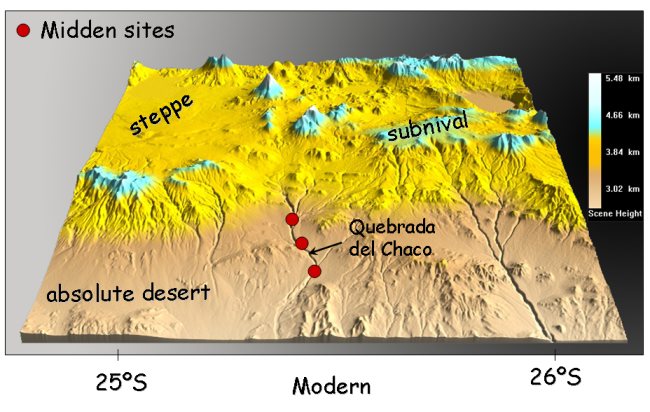
Generalized, modern vegetation zones in the region of Quebrada del Chaco. Source: United States Geological Survey
The Associated Press released this report on the desert whales of Atacama this morning at 12:08 a.m. EST. (See also this blog entry from Nature.com, and other articles here and here.) Paleontologists have found at least 80 whale skeletons, which the sedimentary rock and desert sands have preserved almost perfectly. The find is at least half a mile inland.
Tellingly, the AP article does not mention the elevation of the site. It does, however, name the nearest town. This is Copiapó, Chile. (Last year, 33 miners waited for 69 straight days, trapped at the bottom of a mine shaft near that town until rescuers could drill down to them and lift them out.) Elevation: 391 meters, or 1,283 feet. Not as high as the Atacama Plateau, but definitely not at sea level, either.
The favorite theories about how the desert whales came to rest in this spot are:
- They beached themselves over a period of thousands of years, 7 million years ago.
- They swam into a lagoon, and later an earthquake or storm cut the lagoon off from the ocean.
Ironically, a road-building crew, building the Pan-American Highway, found the first signs of the desert whales. The Chilean government plans to build a museum to house the remains where they lie. It would be an extension of the Paleontological Museum in Caldera.
Problems with conventional theories
The obvious problem is: How did eighty whales wash ashore, half a mile inland, and at an elevation greater even than the height of the Empire State Building? The project scientists talk hopefully of scour marks or deposits of gypsum or crystallized salt. But they cannot explain finding so many whales, all in one spot, more than 100 building stories above the beach. That could be why the Associated Press neglected to report an elementary fact like the elevation of the site of the desert whales. (They named the town, but tried to imply that the site is much lower than the town actually is.)
The real answer
[ezadsense midpost]
The most likely solution is the obvious one: the Atacama Desert region, including Copiapó, was once underwater.The Atacama Plateau rose up when the Andes Mountains formed and then sank into the earth’s crust. (Every mountain chain has a plateau next to it, on either side. The Andes are no exception.) The future site of Copiapó rose also, though not as high as the plateau.
And when was the Atacama Desert underwater? During the Global Flood, of course. The Andes are in fact part of a much longer chain of mountains that stretches from the Yukon Territory to the tip of South America. Those mountains formed when the continental plate holding the Americas crashed and buckled. (That in turn happened after the event that formed the Mid-Atlantic Ridge shoved the Americas westward—hard.) When such high mountains form, they sink. As they sink, the land around them rises. The rise of the Colorado Plateau trapped two great lakes, which later spilled their contents and carved the Grand Canyon. The rise of the Atacama Plateau and other lands downslope and to the west, we now know, trapped the desert whales. Large amounts of sediment buried them, and the dry winds preserved their remains for thousands of years after that. (For details, see this excellent description of the Hydroplate Theory of the Global Flood.)
This is some of the most striking evidence yet for a global flood. How paleontologists will avoid that explanation should interest any student of logic.
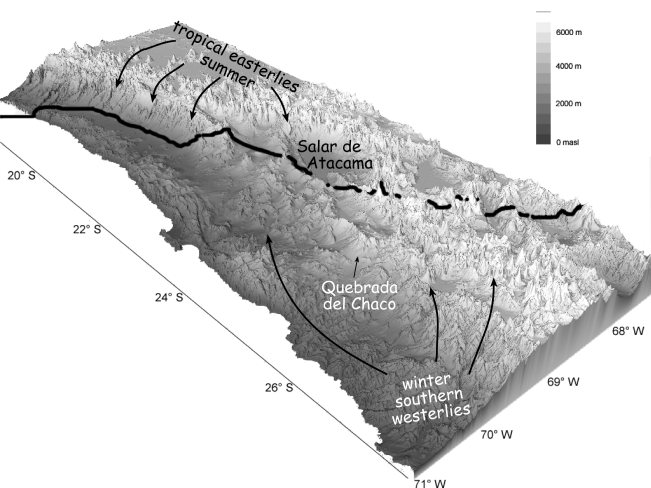
Featured image: Digital Elevation Model of the Atacama Desert and Pacific slope of the central Andes, showing boundary (also referred to as Arid Diagonal) between tropical easterlies/summer precipitation that originates in the lowlands of the Amazon Basin and Gran Chaco. Since 1997, Desert Laboratory scientists have been collaborating with Chilean scientists to reconstruct the climatic, hydrological, and ecological history of this fascinating area, using plant assemblages from fossil rodent middens and the stratigraphy of wetlands. Our initial studies concentrated on the area around Salar de Atacama, but we continue to fill in with new sites along a 1200-km latitudinal transect, including Quebrada del Chaco. Source: United States Geological Survey.
[amazon_carousel widget_type=”ASINList” width=”500″ height=”250″ title=”” market_place=”US” shuffle_products=”True” show_border=”False” asin=”1878026097, 0890515077, 0310234697, 0875523382, 0890511586, B002RBHDFK, 0949906689, 0890513600, 089051416X, 0890515050″ /]
[ezadsense leadout]

Terry A. Hurlbut has been a student of politics, philosophy, and science for more than 35 years. He is a graduate of Yale College and has served as a physician-level laboratory administrator in a 250-bed community hospital. He also is a serious student of the Bible, is conversant in its two primary original languages, and has followed the creation-science movement closely since 1993.












-

 Executive2 days ago
January 6 case comes down to selective prosecution
-

 Executive1 day ago
Biden ballot woes continue
-

 News3 days ago
Rolling the Dice on Republicans: Has the Right Become Delusional?
-
 Civilization2 days ago
President Biden Must Not Encourage Illegal Mass Migration From Haiti
-

 Executive2 days ago
Why Fatal Police Shootings Aren’t Declining: Some Uncomfortable Facts
-

 Civilization3 days ago
Biology, the Supreme Court, and truth
-

 Constitution2 days ago
Equality Under the Law and Conflicts of Interest in New York
-

 Guest Columns2 days ago
What Was Won in No Labels’ Crusade
Or it was because of an ice age.
Or it was when pangaea split.
Or it was god putting them there directly when he made the earth 6,000 years ago, just to mess with the evolutionists.
The third part would be well within Divine power, but is not consistent with the narrative. As to the first two, I have news for you: the Hydroplate Theory explains both those observations, and a “whale” of a lot more, besides.
Hydroplate Theory is just a theory, and is not proven. Therefore, it was when a whale carrying meteorite crashed into the mountains of Chile.
Don’t be absurd.
Please tell me you’re not using the “just a theory” argument that creationists are all-too-often criticized about?
Nor is the Plate Tectonics Theory, Evolution, The Big Bang or even the theories on the formation of Planets, Stars, Comets or a host of other items. None of the theories are proven and all are based upon conjecture and most require lots of assumptions and billions of years. You should get the book and read it. You might be surprised at the number of holes and assumptions all of the other theories have and need.
Brown’s theory is a whale of a tale.
Funny thing…. Brown says he won’t debate me in writing because I lack a PhD and he doesn’t want anyone complaining about the lack of qualifications his opponent holds. On the other hand, he is more than willing to debate me verbally. I have to wonder…. what is it about a verbal debate that increases my level of qualification? Couldn’t those very same people make the EXACT SAME claim with regard to my qualifications in regard to the verbal debate Brown insists on?
You know what you can do to address the deficiency: sign on an actual PhD holder and form a team. The written debate format requires that the team leader have the PhD. The verbal (telephone-recorded) debate format is more like an on-the-fly discussion.
Having read Dr Walt Brown’s book “In the Beginning” finding whales in the mountains is not be surprising to me. Anyone who wants an alternate description of various existing theories that is based in science should read the book. The Plate Tectonic theory still has lots of holes and can not explain many of the physical structures on earth consistently without lots of assumptions. Dr Brown’s theory explains a lot of things scientists are still trying to explain. And is starts with a minimal assumptions of starting conditions.
When I first heard about the theory I found it interesting and did some more research. He discusses his theory and even his theories weaknesses honestly. He also discusses the gaps in the other theories and their circular dependencies which anyone when told about these circular dependencies would raise questions about the validity of these theories.
And I can understand why “natural” based scientist won’t like the theory – it undermines all of the “billions of years to do this and that” based theories and consider that there must be a designer. It will force lots of scientist to abandon their pet theories. Even the Institute for Creation Research will have to rethink their theories. But that is the nature of real science – new ideas replace old ones by explaining observed facts better than that was done before.
I’m an old “earther” who believes God started from scrath however long ago He thought he’d need to to give people who didn’t want to bend their knee to Him enough rope to make their decision plausible. That said, I’m also a geologist who studies the earth for fun and profit (or prophet, if you take it a different direction :-)).
Anyway, with God a day is as a thousand years, etc., and so time is of little consequence to Him or His plans for bringing His children to love Him for who He is (not necessarily who they may want Him to be). The mountains, are far as we can tell today, do arise as the plates move around the surface of the earth, though in a more unsophisticated, but accurate explanation, they are the cool milk skim floating and bobbing around the top of a boiling saucer of milk. Up and down, all around.
As parts of the plates are compressed, like you say, there are areas that are pushed up, like ice along a lake. Then areas on either side MAY be slightly folded down by that compression forming basins (where sediment from the mountains can collect as the mountains rise). A beautiful dance when taken all together.
The Andes are an area that have been rising in general because the South American plate, made of lighter weight silicon rocks is being pushed up and over the heavier basaltic rock that makes up the rock under where the water lies (in this case the southeastern Pacific). The plateaus which are outside of the areas which are faulted and coming up faster, are also rising with them.
As a note, the river and it’s water I think you referenced for carving the Grand Canyon has been draining the Western US a lot longer than since the melting of the last ice age and the forming of the huge lakes in Wyoming, Colorado, Utah and Nevada (Lake Bonneville, etc). The Grand Canyon is located in a domed up area, looking like a flattened half of a grapefruit, caused by the continental bumping around as you mentioned. However, because it was already in place, it sliced through the doming rock as it came up. It came up slower than the river could cut, so the river remained in about the same place even as the sides grew higher and higher.
All in all, God has given, to those of us who see his incredibly detailed and long term handiwork, as much evidence as a person with an open heart needs, but not so much that Satan can say “Well, of course they accept you, you didn’t give them any choice.”
Alan, you sound as though your heart is in the right place. Now please, do yourself a favor and read Walt Brown’s book. He’ll show you that the changes you mentioned took place a lot more quickly than you suppose.
Remember, he’s taken the conventional geology courses. So he knows where you’re coming from, and knows where conventional geology has gotten it wrong, and how.
Alan – Definitely get Dr. Brown’s book “In the Beginning”. Like you I was an “old earth” person. His book while easy to read is very detailed. I took around 1 month of careful reading and considering to insure I understood what he was proposing. He has math, logic and solid reasoning on his side. And he has basically a single assumption for his theory – a layer of water between the crust and mantel rocks around 10 miles down.
He also points out where his theory has problems with issues and points out where he believes other theories have problem.
When I saw this news on another website about these whale remains, my thoughts were directed to a couple of Scriptures which aptly describe the mentality of those “scientists” who consider their burial grounds such a mystery:
Rom 1:22 – “Professing themselves to be wise, they became fools,…..” [KJV]
Pro 26:12 “Seest thou a man wise in his own conceit? there is more hope of a fool than of him.” [KJV]
What frustrates me the most, (though), however, are those professed Christians who give credence to the pseudo science (theory) of evolution:
“Evolution:” Rejected by Jesus Christ
link to thechristianmessage.org
Are you sure Atacama desert is only only 60 feet wide?
I’ll tell you this much: the whales’ graveyard is only about half as wide as a football field.
It doesn’t matter that the land is at such a high elevation – it wasn’t at the time the fossils were deposited. This is known without even finding the fossils.
The only thing scientists are perplexed about is how so many whales were trapped in the same place. Obviously they were accumulated and died on the shore. A global flood has no shore and would leave whales evenly strewn about. If this supports global flood so well, how do you account for the clustering of fossils?
The rise of the mountains, and then of the plateau, occurred in a rapid sequence. Rapid enough for the whales to get caught in some of the valleys where the waters drained to a basin that later dried out.
I truly believe it took 40 actual days to get the water up high enough to do what Moses recorded. I believe it also took another 100 days or so for it to drain away. It’d be nice to know where it went, but up to now I don’t think we, or you, do.
There are things that have happened in the universe and on earth that we haven’t anything but a clue about. If you think you really know with such little actual data, you are silly. You are also insulting God’s intellect. What arrogance can you have to be so vehemently sure you have found the answer. In science, and in theology, knowledge comes with the world of experience being brought more and more to bear on the subject, whatever it is. Look at how God taught us the basics of who He is. He made the data such that you can go many ways with it. Man has to have a choice or Satan wins.
I’m not sure whom you’re addressing with this. I would say that if anyone has shown arrogance lately, it’s the uniformitarians, not the creation-oriented scientists.
What is more telling is you didn’t even investigate the area. It says that the fossils were found near Copiapo, Chile. Copiapo is 70km drive from the from the ocean and it only has an elevation of 400m. I said drive, the road is not straight. I will err on the side of caution and say that it is only 40km from the ocean. Using similar triangles 1km from the ocean is only 10m above sea level.
Okay that is a ridiculously simplistic model, but looking at the area on Google maps with terrain view on and there are areas as far as 4km inland where it is only just reach 100m. This is consistent with the current scientific paradigms. There are places in that coastal are where sea leaves 50m higher and the coastline is 1.4km further in land.
What a mess. Last sentence should read: There are places in that coastal area were the sea level was 50m higher the coastline would be 1.4km further in land.
James, what? Form over substance?
I notice that none of the stories you cited mentions that the skeletons were 13000 feet above sea level. Then I looked at some other pictures, and I found out why. The pictures make it obvious that the site is not 13000 feet above the sea. But facts should never be allowed to get in the way of a good story.
link to dailymail.co.uk
The stories themselves said nothing about the elevation. They would have you believe that the whale find was at sea level. I had to look elsewhere for any, repeat any, discussion of how high up the Atacama Desert is.
I think the reason they’d have us believe that is that the fossils were found so close to the sea that you can see the beach in the photos. Still, we all make mistakes. Own up to them and there’s no harm done, eh?
It seems like you didn’t like my last two comments. I can’t imagine why. Anyway, can you confirm for us exactly how far above sea level these fossils WERE found?
Nope–just late in seeing them. But now I have to confirm some of the remarks listed above. It wouldn’t be the first time that someone, claiming to have the better of me, turned out to be lying.
OK, no problem, I did notice that those two comments seemed to reappear at some point; technology’s wonderful sometimes. However, as for the whales, when you confirm that the fossils were found at a low elevation less than a mile from the beach can I assume that you’ll give a retraction for this article?
I’m looking at this right now. The nearest town is Copiapó, which incidentally is the place where those miners spent months trapped in an inaccessible shaft. Elevation: 1281 feet. Not nearly as high as the Atacama Plateau, but definitely not zero, either.
Just go look at the Daily Mail (not exactly a loony liberal paper) article that 1Lishell linked. There’s photos of the excavation site and you can see the beach. Height above sea level? 150 feet, max.
Terry, have you looked at the photos in the Daily Mail article?
A clarification will appear within a few minutes.
We have seen recently that whole pods of whales, 70 or so beached themselves. Don’t really know why, but we don’t need a scenario where they were somehow trapped.
Can we please have some confirmation about the actual altitude of the whale fossils, and not just the highest part of the desert (which could, of course, be hundreds of miles from where the fossils were discovered?) Is there any truth in the claims by scientists that this site is in fact less than a mile from the coast and only 300 feet high?
The article states that the whales were found half a mile from the sea. Unless you’re claiming that in half a mile the land rises up 13,000 feet I think you’ve made a bit of an assumption. The Atacama desert is not of uniform height.
Oh dear, another creationist mountain out of a scientific molehill – literally. Claims that the fossils were found “as high as an airliner flies” is pure sensationalist bunkum as the reported location of the find is only half a mile from the coast near Bahia Inglesa and in these pictures from AP you can clearly see the sea in the background; the elevation is actually much closer to 130 feet than 13000 and therefore poses no issues whatsoever for secular geologists. If you knew anything about geography (or could be bothered looking) you would know that the Atacama Desert actually includes the lowland coastal strip as well as the high plateau. The inclusion of a some digital elevation model to illustrate your story is deceptive window-dressing.
Deceptive? Oh no. I’m 100% sure that Terry has made an honest mistake here and will soon be publicly retracting it, as well as taking it off the main page of the absurd Conservapedia blog.
I’m not holding my breath that Mr. Hurlbut will respond to any more comments now that his claims have been shown to be ridiculous.
Wrong again. You might want to re-read the article. Changes appear in boldface.
And for the record: you guys went overboard, by trying to imply that those whales were found either at sea level, or not more than 150 feet up. In fact it’s more like 1283 feet up. That’s still plenty high.
You need to do more research Terry. Copiapó may be at 1238 feet, however the discovery is close to the coastal town of Bahia Inglesa, check the photos – you can sea the sea. But don’t let facts get in the way of a good straw man argument.
Nobody cares how high up the nearest town is. What matters is how high up the fossils were found, and we can tell that from the photos: no more than 150 feet. Terry, the whales are practically still on the beach. Are you going to retract this or not?
I’m inclined to agree. From reading Terry’s own sources it’s fairly obvious that the area in question is about 130 feet above sea level, certainly not 13,000 ft. Unless Terry knows of a massive 4 mile cliff along that coastline.
Sadly, the only argument Terry had in favour of the Flood was the elevation, which clearly seems to be something he’s invented.
Will we see a retraction / apology?
To quote the article “a kilometer (half a mile) from the surf”
Now any piece of land rising 2.4 miles (to correct my earlier comment – we’re metric down here) within half a mile must be pretty spectacular. A shame it doesn’t exist there.
In addition link to archaeologynewsnetwork.blogspot.com says: “The area outside the town of Bahia Inglesa” Now If I Google “Bahia Inglesa” I find the following:
“Bahia Inglesa (“English Bay”) is a village and beach located near the port of Caldera in Atacama Region, Chile. Bahia Inglesa is renowned for its white sands and warm waters.” And no mention on a massive 2 mile high cliff behind it.
Then again, I suppose it could be as high as airliner… if it was landing at sea level.
Terry go to Google Maps and look for Bahia Inglesa, chile. You can clearly see the unfinished highway, it is marked by shields with the number 5 on them. Switch to terrain mode and look at the topography lines, the highway is built on land no higher than 125m.
One thing people need to remember is that geologist use fossils to date rocks and then the fossils are dated using rocks by making assumptions of how the long ago the rocks were created. Circular reasoning. And even the various dating methods are inconsistent with each other.
People should take the time to read the book and consider all of the assumptions geologist and evolutions makes in order to try and get their theories to work. For instance if evolution actually was occurring we should see transitional species all over the place. Dr Brown’s theory answers a lot of questions “all is nature” scientists can not explain. Then the article’s basic statement will understood a lot better. Finding these whales in a massive layer of sediment supports a major flood event. Something had to bury them and do it fast and in a way to prevent access. Otherwise the whales would have been eaten.
And we have modern day evidence of just how fast things can be carved and constructed. Look at the things Mount St Helens created. The canyons and “forest above another forest” structure. Such forest structres were thought to take thousands of years yet Mount St Helens did it in a few days. The Hydroplate theory explains how the whales could be trapped and how they could be fossilized in days or weeks. But you have to look at the evidence as is. His books discusses this starting on page 169. You can not state the whales are millions of years old. That is assumption based upon flawed theories and circular reasoning.
When one looks at how sediment can trap things imagine what a massive flood and various uplifting can do. Just think of how quicksand and other liquefaction environments can sort things.
If you take the time to read the whole book, it is only 430 or so pages, you can see why sea life fossils would be in high mountains or buried in sediment layers. And one must remember that the established laws of thermodynamics work against evolution not for it. Ever seen a car get better?
The evidence for the Hydro Plate theory is out there and the Whales are just one more example. We know how fast sediment can form and trap animals. I wonder how many trapped animals around Mount St Helens would be considered to be hundred of thousands of years old considering the sediments created.
And Terry described the desert – he did not say where the whales were in the original posting. And note this from the original story
“Tellingly, the AP article does not mention the
elevation of the site.”
So Terry never implied any information about altitude.
“So Terry never implied any information about altitude.”
Yes he did. His article originally said that the fossils were at an altitude of 13,000 feet. When he could no longer deny that this was untrue he edited it to say they’re at an altitude of at least 1,283 feet. So far he hasn’t admitted that this isn’t true either and that the actual altitude is more like 150 feet. However he will, because there’s too much evidence for him to keep denying it for long.
“geologist use fossils to date rocks and then the fossils are dated using rocks”
Actually that’s not true at all. Fossils are indeed dated by the rock strata they’re in, but the strata are dated using radiometric dating techniques (which DO agree with each other, usually to within 1%.) Before criticising geologists, why don’t you learn something about geology?
First of all, those techniques do not agree. Often the same technique, applied to multiple samples from the same source, gives wildly different answers.
Second of all, those techniques postulate that the earth is old. If the earth is young, all bets are off.
“Often the same technique, applied to multiple samples from the same source, gives wildly different answers.”
I can dismiss that with one word: xenoliths. And of course actual scientists doing radiometric dating, as opposed to people just trying to discredit the method, understand this and don’t take test samples from xenoliths.
“Second of all, those techniques postulate that the earth is old. If the earth is young, all bets are off.”
No. All these methods postulate that radioisotopes decay at a predictable rate, which is an observed fact and has been known for as long as we’ve been able to measure decay rates. If the Earth was young we’d see very different results. We don’t. Ever.
You’re making an assumption for which you laid no foundation: namely that Steven A. Austin and his team, who did the Mount Saint Helens study, submitted a sample full of xenoliths (or xenocrysts, “strange glass,” which is what I think you meant). Austin has specifically repudiated that charge many times over. Now you are free to believe him or not as you wish. But I accept his word, at least on that account.
Actually, radiometric dating postulates three things: that radioactive decay rates never change, that the initial concentration of daughter nuclide was zero, and that nothing other than radioactive decay changes the composition of any rock. None of those assumptions are axiomatic, and all three turn out to be fatally weak.
Actually radiometric dating makes none of those assumptions. The decay rates are MEASURED, the isotopes used are carefully selected so that the daughter products are not ones that are naturally found in rock (gases are a favourite) and the same fact deals with the third claimed assumption. Radiometric dating is hard science. It works.
And no, I meant xenoliths: inclusions in igneous rock, which date older than the rock that surrounds them.
See what I mean? You admit that you’re making an assumption with every statement you make. Decay rates are measured–big deal. How do you know that the decay rate stayed the same since time immemorial? Daughter products are not “naturally found in rock of that kind.” Again: says who? Says what?
And I still say that Austin repudiated that last canard that you insist on repeating.
“How do you know that the decay rate stayed the same since time immemorial?”
Because I understand the forces that hold atoms together, and why they can’t vary much without the universe dissolving into a plasma.
“Daughter products are not “naturally found in rock of that kind.” Again: says who?”
Say all the people who understand how the isotopes used for dating were selected. They didn’t just pick isotopes with cool names; all these potential flaws were CONSIDERED. Look at the K-Ar method. Argon is a GAS. Argon-40 ONLY forms when K-40 decays. How else would it get in the rock?
And how do you know that the decay rate was constant?
Funny you should mention plasma. That’s what much of the minerals in the earth’s crust turned into during the Flood. Ever wondered why nobody ever goes prospecting for radioactive ores on the ocean floor? The land areas were subject to those great earthquakes I mentioned earlier, heavier than you can imagine. All that quartz in the crust produced tremendous electrical potentials. Enough to create lightning in the ground itself, and to turn everything in its path into plasma. And plasma decays faster.
But more than that: radioactive elements didn’t just decay faster. They got made in that process. This synthesis of radioactive elements went at least as high as uranium.
The one thing I fault Austin on, is not thinking about where the radioactive elements came from, and how they formed. Hint: we’re not stardust. Radioactive elements didn’t exist before the Flood. They are the most spectacular leftovers from that event.
They make assumptions about how long the strata took to get laid down to determine the ages. Then they use assumptions of fossils based upon unproven theories to further decide ages. It is called circular reasoning. Fossils of sea life are found in the upper reaches of mountains and therefore life must be millions of years old since the mountains took millions of year to get to 20 or 25 thousands feet. In other words – an assumption of time yields an age and thus the fossils must be ancient.
And the age tests have been shown to be questionable. If the tests were accurate then tests using different methods should yield comparable ages. Yet the don’t. The tests make assumptions about decay rates and other items. Or in other words – assumption after assumption.
And Mt Saint Helens showed just how questionable those assumptions are. And he addressed this issue in the book as well.
So I will stand by my statement of circular logic.
“It is called circular reasoning.”
It would be if that’s how strata were dated. It isn’t.
“Fossils of sea life are found in the upper reaches of mountains and therefore life must be millions of years old”
Nobody makes that assumption. The fact is that any suggestion that fossil sea life ended up on mountaintops by any OTHER process is absurd. Whether a global flood happened or not (hint: it didn’t) sediment would not have been laid down on mountaintops.
“If the tests were accurate then tests using different methods should yield comparable ages. Yet the don’t.”
Actually yes, they do. Check your facts.
“The tests make assumptions about decay rates”
No, the tests use MEASURED decay rates.
“And Mt Saint Helens showed just how questionable those assumptions are.”
No it didn’t. Please, don’t waste my time talking about “mini Grand Canyons” or any of teh otehr Mt St Helens tripe.
“So I will stand by my statement of circular logic.”
Fine. However I will stand by my suggestion that before criticising geologists you learn some basic facts about geology.
Terry, as a creationist you are obviously conditioned to reading everything in a literal fashion; however, when the media mention a location in a foreign country they tend to refer to the nearest large town or city. It has already been pointed out to you that the fossil site is near the small coastal town of Bahia Inglesa so here’s another link from an AP press release which explocitly mentions this. I presume that your are smart enough to do a search for Bahia Inglesa on Google maps and see that it is a small coastal town near the larger one of Caldera, while Copiapo is the regional capital some 40 miles inland and much larger. Here’s a page about the paleontological museum in Caldera, not Copiapo. Now, before you finally condescend to admit that you got this one wrong and endeavour to save some creationist face, let me say that the discovery of so many fossils in one location poses absolutely no problem for secular science. By the way, I have e-mailed the museum and will send you the exact location and elevation when they reply.
Once again, quoting from the sources used in the article:
“The finds, made near the northern city of Caldera” (link to blogs.nature.com)
Caldera is a “port city in the Copiapó Province of the Atacama Region in northern Chile.”
Once again, Terry is miles off, both in his location of the dig and its elevation.
Then why did the captions on the two photographs say that the site is near Copiapó? Caldera is merely the headquarters or branch office of the Paleontological Museum. It is not the site of the desert whale pod.
If you people are wondering why no “retraction” is forthcoming, here’s why: Journalistic ethics do not oblige me to issue a retraction on no person’s word except from a side that already has multiple problems with the truth. Especially when that side can’t get its story straight.
The captions might say that, it being the largest town and capital of the region, but all your other sources refer to “half a mile from the surf” and the towns of Caldera and Bahia Inglisia. Given that Copiapó is 40 miles inland, how can it also be “half a mile from the surf”?
Given that the Copiapó reference comes only from a mainstream media source, I’d be inclined to go with the reporting from Nature et al. Of course, you’d go the opposite way and claim the source that matches your point of view.
Which brings us to the journalistic integrity you mention – journalists are supposed to report facts, not twist them to suit the story they want to write.
I find the discussion above ironic given that it denies most conventional creationist literature. But then again, Dr. Brown’s theory is far from conventional in any respect. AIG/ICR etc. are not consistent even within their own theories but the basic gist of conventional flood geology is that much of the upper sedimentary rock was formed after the main events of the flood. The rock that these whales are found in would be defined as post-flood rocks and thus the explanation for the whales by conventional flood geology requires a post-flood explanation. I have no idea what that would be but the point is that these whales are much more of a problem for flood geology than conventional old age geology. Especially when one considers that these whales are very similar if not the same as species of baleen whales found alive today and most bariminological studies of creationists suggest that modern whales are evolved from some more primitive whale kind and that the diversity of whales was likely not present before the Flood.
Keep in mind ICR does not like Dr Brown’s Hydro Plate theory. In his book he also takes apart their canopy theory and shows how it is falls apart in face of known scientific laws and physics.
And the hydroplate theory does not fall apart in the face of known scientific laws and physics?
No, it doesn’t. That is why people need to actually read the book so they understand. For instance, 2 deep drilled wells (5 to 7 miles or so) have encountered supersaturated salt water. And scientist have also called stated experimenting with Super Critical Water (SCW). The theory is based upon science and observable facts.
Consider the Plate Tectonic theory which was ridiculed for years until various structures were discovered thus giving it credence. Yet the theory still has massive holes and can not explain a lot. Dr Brown’s theory explains things that all of the other theories can not or require the “billions of billions” of years, other assumptions and conjecture. Yet still can not explain the how and whys. Dr Brown is not afraid to point out where his theory has problems and does so in his book.
The book is worthwhile reading. And his theory is based on observable and testable science, physics and math. Look at how much scientific theory is not testable and yet it is presented as fact.
Name a hole in the theory of plate tectonics. Bet you can’t.
I really don’t know how much evidence you need but try this website for Centro de Estudios Paleontológicos de Chile, you will need to scroll to the bottom to see the latest text.
Translated from link to cepchile-paleontologia.es.tl
——-
Caldera Museum of Paleontology
GREATEST DISCOVERY cetacean paleontological AMERICA
In the town of Caldera (III Region) reported a finding that could become the largest cetacean paleontological site in America whose data is estimated at approximately 7 million years. (Upper Miocene). The fossil remains of whales are in good condition and are being studied by paleontologist Mario Suarez, Curator of the Paleontological Museum of the Caldera, who personally oversees the work of exhumation and preservation of the fossil material.
Paleontologist and Curator of the Paleontological Museum of Caldera on the site were found numerous remains of cetaceans fully articulated. These fossil finds are one of the most important milestones in paleontology in Chile in recent times.
The discovery of this site paleontological and scientific research work involves connotation and significance for world class and again to appreciate that Caldera is the most important fossil deposit in Chile and is providing materials contained fossils of great paleontological importance, reality which is reflected in the numerous scientific publications that are constantly reporting the discovery of new remains of vertebrates, particularly marine, in the place.
The work of Suarez and his team is basically to protect the fossils while obtaining resources to achieve adequate removal of material being excavated.
The Bahia Inglesa paleontological richness make this site in the vertebrate fossil deposit Chile’s most important and one of the most successful of South America.
The discovery of this new site with the remains of whales in the Miocene, has captured the attention of many media outlets are reporting and publicizing the importance of these materials easily, not only to society in general but also to the global scientific community .
Nevertheless, according to Mario Suárez himself explained, not only required to publicize the importance of the paleontological site but also define appropriate measures for the protection of the site, access restrictions and information to protect the fossil site.